






You're probably looking at portable cabins for sale in Ireland because you need space now, not after a long build or a messy extension process. Maybe the garage is full, the children need a quiet room, or you've got a site that needs a welfare cabin, office, or a small accommodation unit that won't drag a full construction project across your year. The mistake most first-time buyers make is treating this like a showroom purchase. It isn't. It's five linked decisions, and if you get any one of them wrong, the cabin becomes expensive very quickly.
Those five decisions are straightforward, but they're not optional. You need to choose the right specification, make sure delivery can reach your Irish site, prepare the base and assembly properly, understand the true landed cost, and read the warranty and aftercare terms before you pay a deposit. The two that catch people out most often are site preparation and planning status, because those decide whether the cabin can be delivered, installed, and used legally on your ground.
Table of Contents
- What to Know Before You Start Shopping
- Matching Cabin Types to Real Irish Use Cases
- Reading the Specification Sheet Like a Buyer
- Base Preparation, Delivery and On-Site Assembly
- Pricing, Deposits and Total Landed Cost
- Planning Rules and Building Regulations in Ireland
- Warranty, Maintenance and Your Pre-Order Checklist
What to Know Before You Start Shopping
Start with the use, not the brochure. A cabin for dry storage, a weekend hobby room, a home office, a welfare unit, and a sleeping annexe all sit in very different regulatory and practical buckets, even if the pictures look similar. A buyer who starts with “I want a timber cabin” usually ends up overpaying for features they don't need, or underbuying on structure, insulation, or access.
Treat the purchase as five separate jobs
Specification comes first. Decide what the building must do in real life, not what looks nice in a photo. If you need year-round comfort or regular occupation, that changes the wall build-up, glazing, floor, roof, and treatment choices.
Delivery comes next. Irish roads, gates, slopes, overhead lines, and turning space can kill a deal that looked perfect online. Many cabins arrive by hiab, so the supplier's reach matters just as much as the cabin size.
Assembly is its own job. A flat, solid base, correct fixings, and a clean installation sequence are what turn a kit into a usable building. If the base is wrong, the cabin will move, trap moisture, or fail to sit square.
Practical rule: never buy on the assumption that “it'll fit somewhere in the garden.” Measure the access route, measure the base, then measure again.
Price needs a landed view. The headline figure is only part of the spend, because base materials, optional extras, delivery conditions, treatment, and assembly all change the final bill.
Warranty and aftercare are the last job. A timber cabin is not a one-time purchase. It needs maintenance, and the guarantee is only useful if you understand what the supplier covers.
Showroom photos hide most of this. They don't show drainage, soft ground, awkward access, or how a cabin behaves after the first wet spell. If you're comparing timber cabins, modular buildings, and log cabins side by side, ask the awkward questions before you fall in love with the look.
Matching Cabin Types to Real Irish Use Cases
Don't buy the “best” cabin in the abstract. Buy the one that matches how you'll use it on an Irish site, in Irish weather, with Irish planning rules hanging over it. That's the true test. A structure can look perfect in a brochure and still be the wrong answer if it needs too much upkeep, won't suit the base, or crosses into habitable use when you only wanted storage.
Use case beats feature list every time
For homeowners clearing clutter, a timber storage cabin often makes more sense than a standard garden shed when the load is more than garden gear and boxes. It gives a tidier finish and a better look against the house, but the trade-off is that you're buying a more substantial structure, so you need to care about base prep and weatherproofing from day one.
For site managers, office and welfare cabins sit closer to modular buildings than to a casual garden shed. They suit temporary compounds, farm operations, and project sites where people need a space that feels proper enough to work in daily. The trade-off is clear, you're paying for structure and usability, not just walls and a roof.
For hosts adding guest space, a residential-spec log cabin is a different product from a glamping pod. A pod can suit short-stay leisure use, while a residential cabin is the more serious option when comfort, privacy, and year-round use matter. The trade-off is also serious, because a residential cabin needs a proper foundation and a maintenance plan, not just a flat patch of ground.
For vehicle cover, timber garages make sense where appearance matters and the buyer wants a softer look than concrete. They work for cars, tools, and light equipment, but they are not a shortcut around structural care. If you want a fully hard-wearing, low-fuss vehicle store, concrete still has a place.
| Portable Cabin Type Matched to Irish Buyers | Best-Fit Irish Buyer | Main Trade-Off |
|---|---|---|
| Timber storage cabin | Homeowner clearing garage space | More substantial than a shed, so it needs better base and moisture control |
| Office or welfare cabin | Site manager, farm owner, or small business | Higher practicality, but less casual than a simple outbuilding |
| Residential-spec log cabin | Buyer seeking guest or annexe-style accommodation | Better comfort, but proper foundation and treatment planning are non-negotiable |
| Glamping pod | Leisure host or campsite operator | Compact and attractive, but less flexible than a full cabin layout |
| Timber garage | Buyer needing vehicle or equipment cover | Better appearance than concrete, but still needs careful site and weather planning |
If you're comparing timber cabins and log cabins, this guide to choosing the right log cabin is worth reading before you settle on a layout. The category matters because it determines the next decisions, especially spec and compliance.
Reading the Specification Sheet Like a Buyer
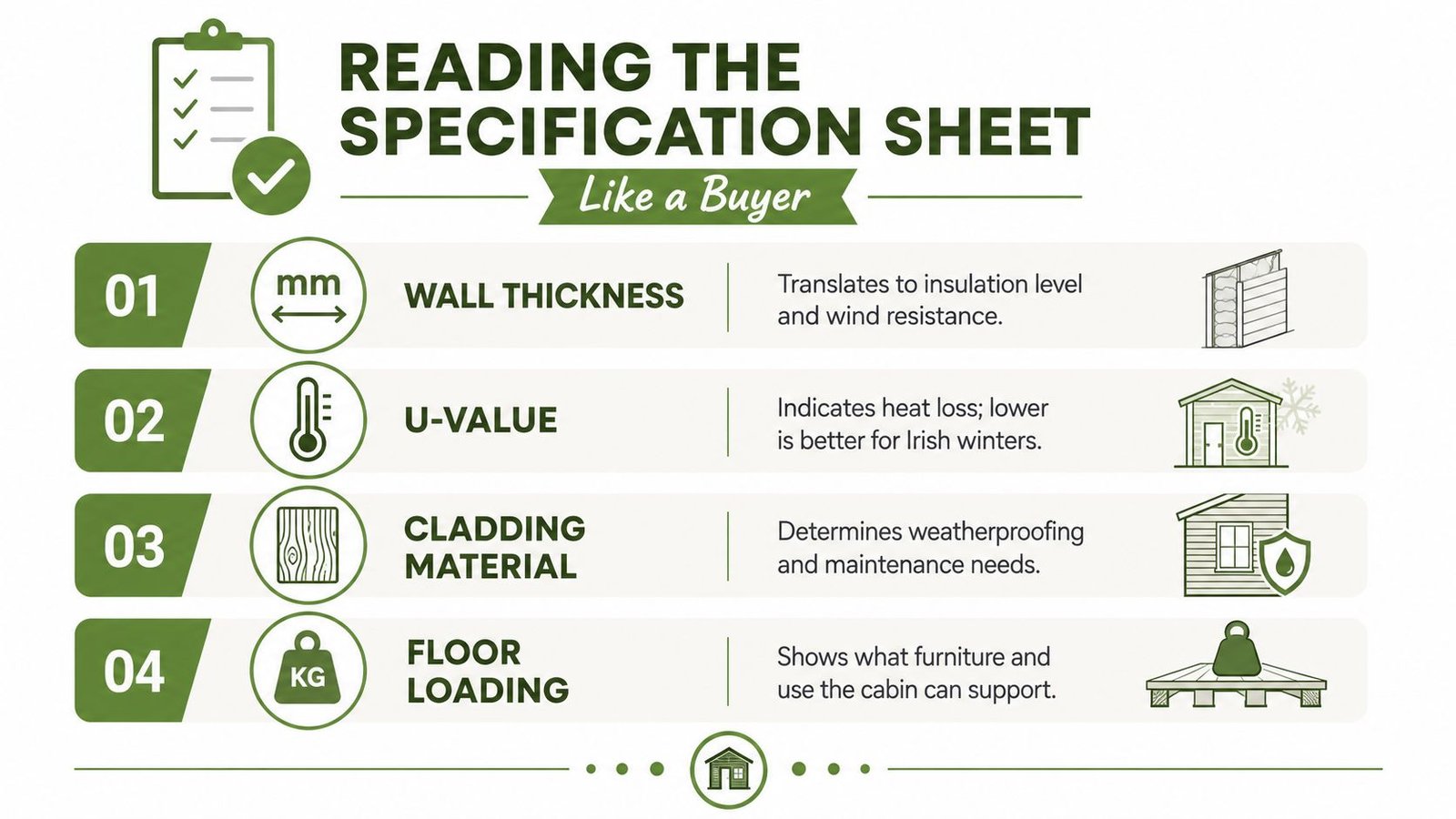
The spec sheet is where a good purchase becomes a bad one if you read it lazily. Ignore the marketing language and look at the numbers, the materials, and the omissions. In Irish conditions, the details that matter are wall build, glazing, roof, insulation, timber grade, and treatment. That's what tells you whether the cabin will feel solid in February or frustrate you by October.
Wall build and glazing tell you how hard the cabin works
Wall thickness is one of the first figures to inspect. 28mm and 34mm profiles are usually better suited to light use, garden rooms, and seasonal cabins. 44mm and 70mm profiles are the more serious choices when you want a room that feels more stable, more substantial, and better suited to regular occupancy. The thicker wall isn't magic on its own, but it gives you a stronger envelope and more tolerance for Irish weather.
Glazing matters just as much, and the seal around it matters more than people think. Single glazing is fine for lower-demand use, but once you move towards office or residential comfort, double or sealed-unit glazing becomes the sensible choice. Rubber or silicone seals do a lot of the quiet work, because wet and windy conditions punish weak joinery long before the glass itself becomes the issue.
A cabin that looks warm on a sales page can still feel cold if the roof and floor are under-specified.
Roof construction needs the same scrutiny. Tongue-and-groove boards are common, but the covering determines how well the building sheds Irish rainfall. Felt, shingles, and EPDM all have different lifespans and detailing demands, and the pitch has to suit the covering rather than just the architect's eye. If the pitch is too shallow for the roof system, water will remind you fast.
Insulation and timber treatment are not extras
Where insulation values are quoted, compare floor, wall, and roof insulation separately. A cabin can look good on paper and still leak heat through the floor or roof if those layers are weak. That's why the whole envelope matters, not one headline figure.
The timber itself also needs a clear treatment status. Dip-treated, pressure-treated, and factory-finished cabins all imply different maintenance rhythms and levels of protection. Ask what's applied at source, ask what needs repeating on site, and ask what the supplier expects you to maintain after delivery.
Base Preparation, Delivery and On-Site Assembly
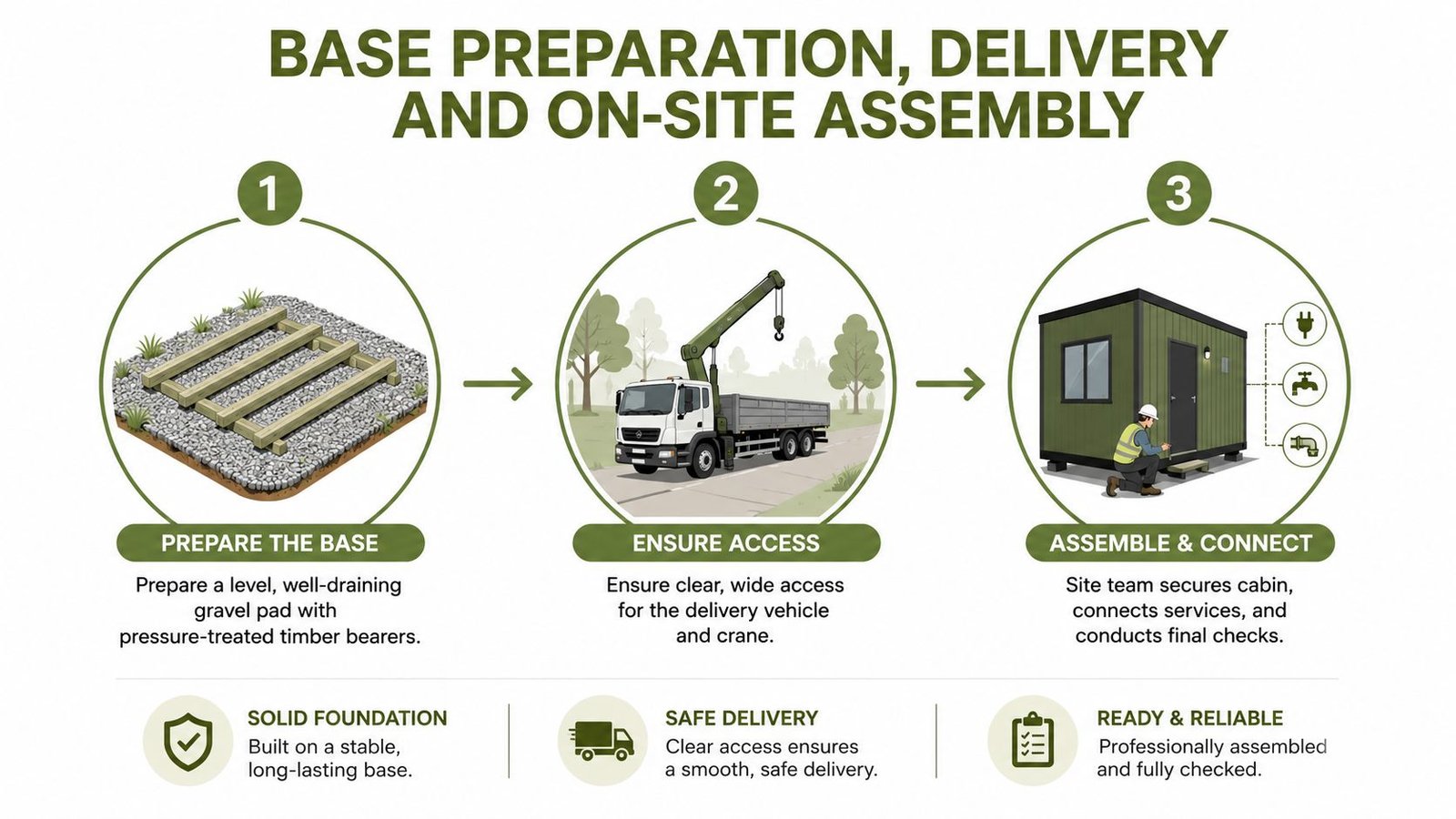
A lot of cabin problems start before the truck turns up. Buyers focus on finishes, then discover the ground isn't ready, access is too tight, or the delivery vehicle can't safely get near the site. That's why the base, access route, and assembly sequence need to be sorted before you confirm the order.
Get the base right first
The base must suit the size and use of the cabin. Pressure-treated timber bearers can work on a level hardcore pad for lighter structures, while concrete piers or a full slab make more sense as the cabin gets larger or more heavily used. On Irish ground, bigger cabins need a more serious base because timber will wick moisture if you leave it sitting wrong.
A practical rule is simple. If the cabin is larger than roughly 3×3m, treat a slab as the safer choice unless the supplier gives a very clear alternative. That's not overkill, it's insurance against movement, damp, and a tired-looking building six months after installation.
Check delivery access like a contractor would
Measure the gate width. Check side-entry clearance. Look up for cables and overhangs. Confirm slope, turning space, and where the truck will stand. Most deliveries rely on a hiab truck with about 8–10 metres reach, so the offload point matters as much as the driveway width.
The assembly sequence should be predictable. Panels come off the truck, the base is squared and levelled, walls interlock, roof boards and coverings go on, then doors and windows are hung. If the supplier offers same-day treatment, that should happen once the structure is closed in and the weather allows.
Do not leave the site team guessing. A responsible adult should be on site to sign for delivery, check the panels, and confirm the installation point before work starts.
Buyers should also have a few basics ready: anchor bolts, silicone, hand tools, and any agreed power or water point if services are part of the install. This is the part of the project where people waste money by being unprepared. The cabin itself is usually not the problem.
Pricing, Deposits and Total Landed Cost
The first price you see is rarely the final price you pay. For a portable cabin, the true number is the one that includes the building, the base, the extra options you genuinely need, and the work required to make it usable on your site. If a quote feels unusually cheap, assume something important has been left out until proven otherwise.
A realistic Meath example
Take a 4×3m timber cabin on a rural site in Meath. The landed cost depends on whether you want supplier assembly or whether you're willing to take on part of the work yourself. The biggest variables are the cabin price itself, base materials, optional flooring upgrades, electrical pack if ordered, delivery conditions, treatment, and assembly scope.
For most timber buildings in Ireland, VAT is part of the final calculation, and suppliers often use a staged payment structure. A deposit is commonly taken on order, with the balance due before delivery. That matters because the payment schedule often lines up with when the warranty clock and production slot are fixed.
| Sample 4×3m Cabin: Landed Cost Breakdown | Supplier-Assembled | Buyer Self-Build |
|---|---|---|
| Cabin price | Base product cost | Base product cost |
| Base materials | Required | Required |
| Optional thicker flooring | If selected | If selected |
| Electrical pack | If selected | If selected |
| Delivery | Per supplier terms | Per supplier terms |
| Assembly fee | Included or added | Saved if not used |
| Treatment and ancillaries | Usually needed | Usually needed |
| VAT and final balance | Due before delivery or on agreed schedule | Due before delivery or on agreed schedule |
The difference between supplier assembly and self-build is not just labour. It's risk. If you self-build, you keep more control over spend, but you also take on sequencing, sealing, and finishing responsibility. If you use the supplier, you pay more, but you reduce the chance of mistakes that become expensive later.
A quote that looks bargain-priced usually excludes the bits people forget to ask about, such as shingles, flooring treatment, or anchor fixings. If those items appear only at checkout, the “cheap” quote was never cheap.
For a more detailed pricing discussion, this log cabin cost guide is useful before you compare supplier figures.
Planning Rules and Building Regulations in Ireland
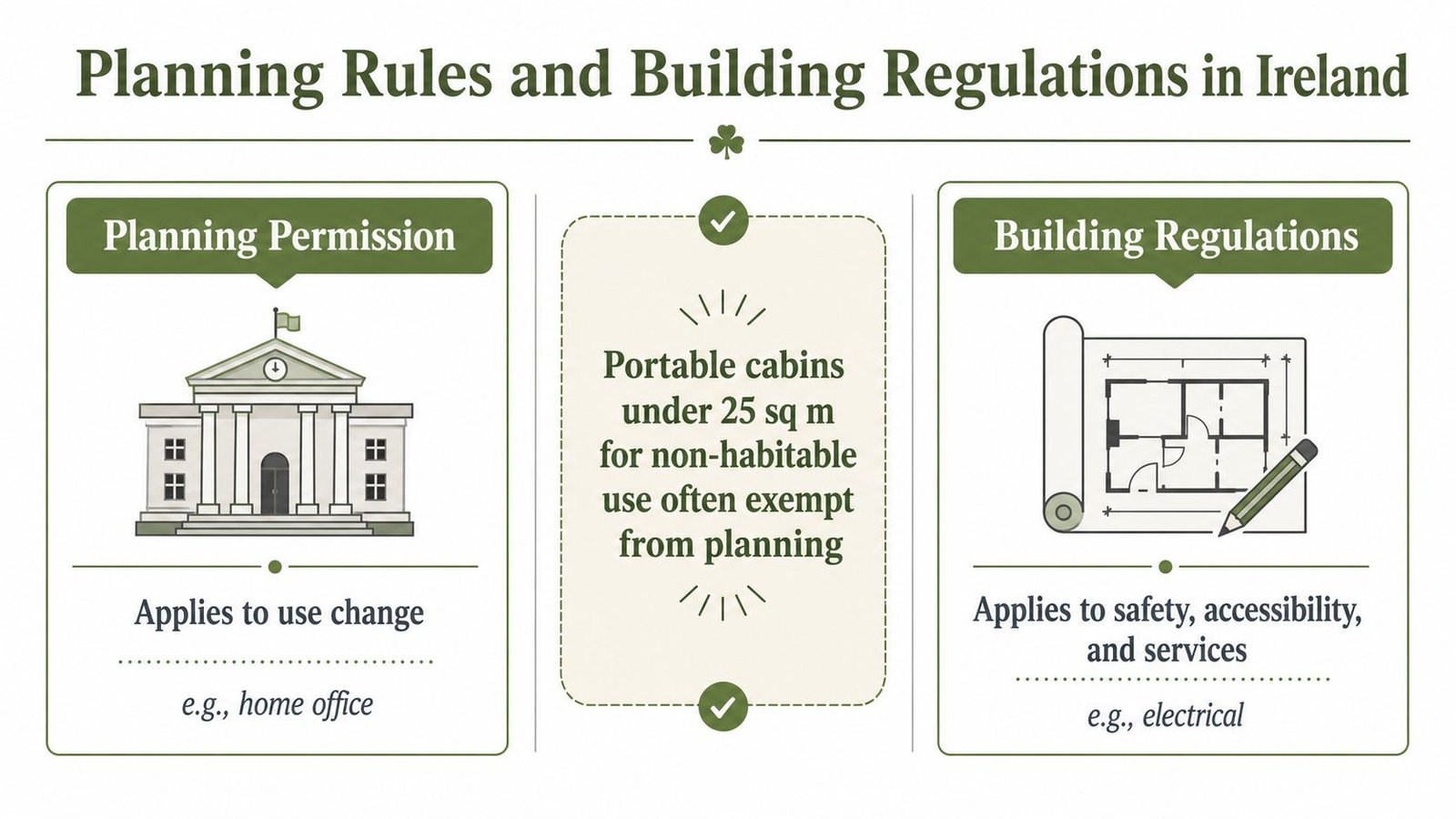
People get tripped up. They assume planning permission and building regulations are the same thing, then discover they're dealing with two separate regimes. That's a costly mistake. Irish planning authorities care about what the structure is used for and how it sits on the site. Building control cares about whether it is safe, compliant, and properly detailed.
Habitable and non-habitable are not the same category
A small portable cabin used for storage, a home office, or a hobby room can often sit within exempt development rules, but exemption is not a free pass. Site specifics still matter, including sightlines, septic arrangements, and whether the property is constrained by other local rules. A buyer should never assume that because one cabin is small, every cabin is fine.
Once the building becomes habitable accommodation, the conversation changes. That includes granny flats, sleeping accommodation, glamping-style residential use, and annexes intended for living. In that case, you should expect full planning permission and the full Building Regulations pathway, including fire safety, ventilation, energy, and completion sign-off.
Practical rule: ask one question before you pay a deposit, “Is this being sold as non-habitable outbuilding use or as a dwelling?”
The planning side has been moving. Irish housing reporting has described changes that relaxed some garden-cabin rules, but the important point is that relaxation did not erase compliance. The new rules still keep setbacks, service connections, and neighbour-impact conditions in place, which means the site and the intended use still drive the outcome.
The building regulations side is equally strict. Irish guidance for portable cabins intended for habitation says you need the technical evidence, the Commencement Notice, the foundation and service details, and completion certification where relevant. A small footprint doesn't automatically remove that burden. Planning exemption and compliance are different questions.
If you want a clearer planning walkthrough, this Irish planning permission guide for log cabins is the right next read before you commit. I also tell buyers to ring the local authority before they sign anything, because local interpretation still matters on constrained sites.
Warranty, Maintenance and Your Pre-Order Checklist
A timber cabin is only as good as the care plan behind it. The warranty matters, but so does what you're expected to do to keep the warranty meaningful. Buyers often read the guarantee length and stop there. That's the wrong habit. You need to know what's covered, what isn't, and how the building should be maintained once it's on your site.
Read the warranty with the weather in mind
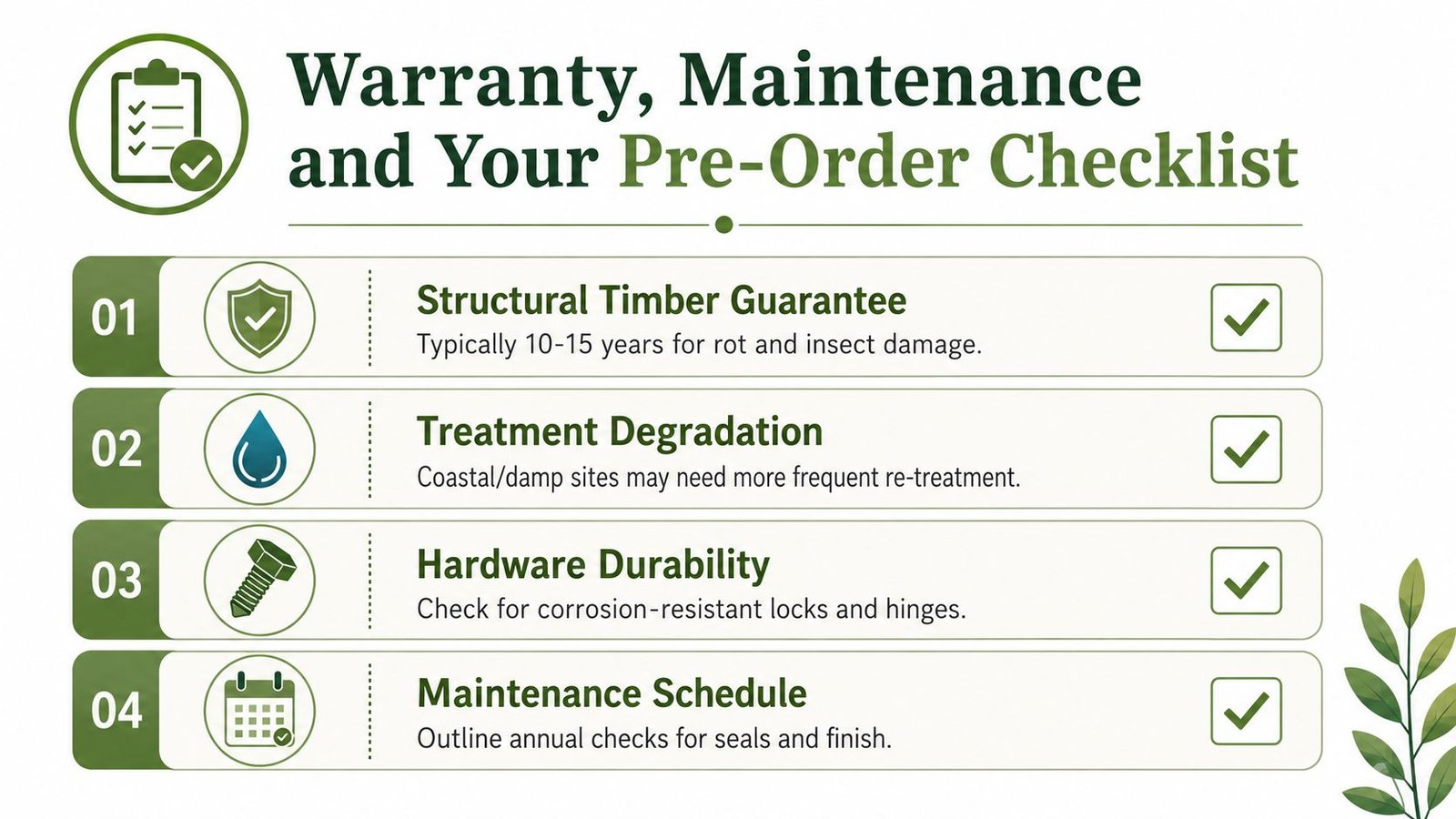
A structural timber guarantee usually covers the frame and main timber elements, but the small print often separates structure from finishes, seals, locks, and hardware. Coastal or damp sites are tougher on treatment and fittings, so corrosion, seal wear, and weathering deserve attention from the first season. If the supplier excludes hardware degradation, you should budget for replacing those items yourself later.
A sensible maintenance rhythm is a 2 to 3 year re-treatment cycle with a fresh coat of wood preservative or oil, depending on the finish. Annual checks should cover gutters, roof coverings, seals, and any early signs of rot where the cabin meets the base. That baseplate area is where neglect shows first.
Sign the order only after you've checked this
- Written quote and delivery radius: make sure the quote says where delivery applies and what happens if access is awkward.
- Deposit terms: confirm how much is due and when the balance is payable.
- Assembly scope: know exactly what the supplier installs and what you must finish yourself.
- Base responsibility: get it in writing whether the supplier or buyer prepares the base.
- Planning status: don't guess, confirm the intended use and whether permission is needed.
- Treatment certificate: ask what finish has been applied and when it should be renewed.
- Lead time: get a realistic schedule, not a sales promise.
- After-sales contact: keep one named contact for issues after delivery.
I'd also check the hardware quality before signing, especially hinges, locks, and glazing seals. Those parts fail long before a decent cabin frame does. If you buy carefully, maintain it on schedule, and keep the paperwork, the cabin should serve its purpose without drama.
TimberLodge365 supplies prefabricated timber buildings for garden, residential, leisure, and storage use across Ireland, with published specifications, delivery, and optional assembly. If you want to compare cabin types, delivery conditions, and aftercare terms before you place a deposit, visit TimberLodge365 and work from the product details rather than the showroom photo.