






You're trying to fit a cabin into a garden that still has to work as a garden. The house needs breathing room, the delivery route can't be awkward, and the build can't swallow the outdoor space you use. In a log cabin back garden project, the strongest choice usually isn't the biggest or the cheapest, it's the one whose footprint, layout, construction spec, access needs and intended use all line up with the site. That matters even more in Ireland, where exempted-development rules have historically hinged on size, siting, roof height and whether the building is habitable (government circular on exempted development).
The seven examples below are best read as different answers to different garden problems. Some suit a compact office or hobby room, some suit a more ambitious residential conversation, and some are better when you want quick supply, factory-direct pricing or turnkey installation. TimberLodge365 is especially relevant if you want published dimensions and specifications, free delivery throughout the Republic of Ireland subject to suitable access, optional assembly and bespoke quoting, without assuming a particular garden has already been measured or approved.
Table of Contents
- 1. TimberLodge365
- 2. Loghouse
- 3. Beaver Log Cabins
- 4. Timber Living
- 5. Timber Kit Buildings
- 6. Eco Home Log Cabins
- 7. Summerhouse24 Ireland
- Log Cabin Back Garden, 7-Brand Comparison
- Turn Inspiration Into a Site Plan
1. TimberLodge365
A good back-garden cabin starts with paperwork, not optimism, and TimberLodge365 is built around that reality. Its product pages publish dimensions, pricing and construction details, which makes it easier to match a cabin to the available space before you commit to a base or a delivery slot. That is a real advantage in Ireland, where a back-garden structure can be compliant in one layout and awkward in another, depending on area, roof form and residual garden space (TimberLodge365 choosing guide).
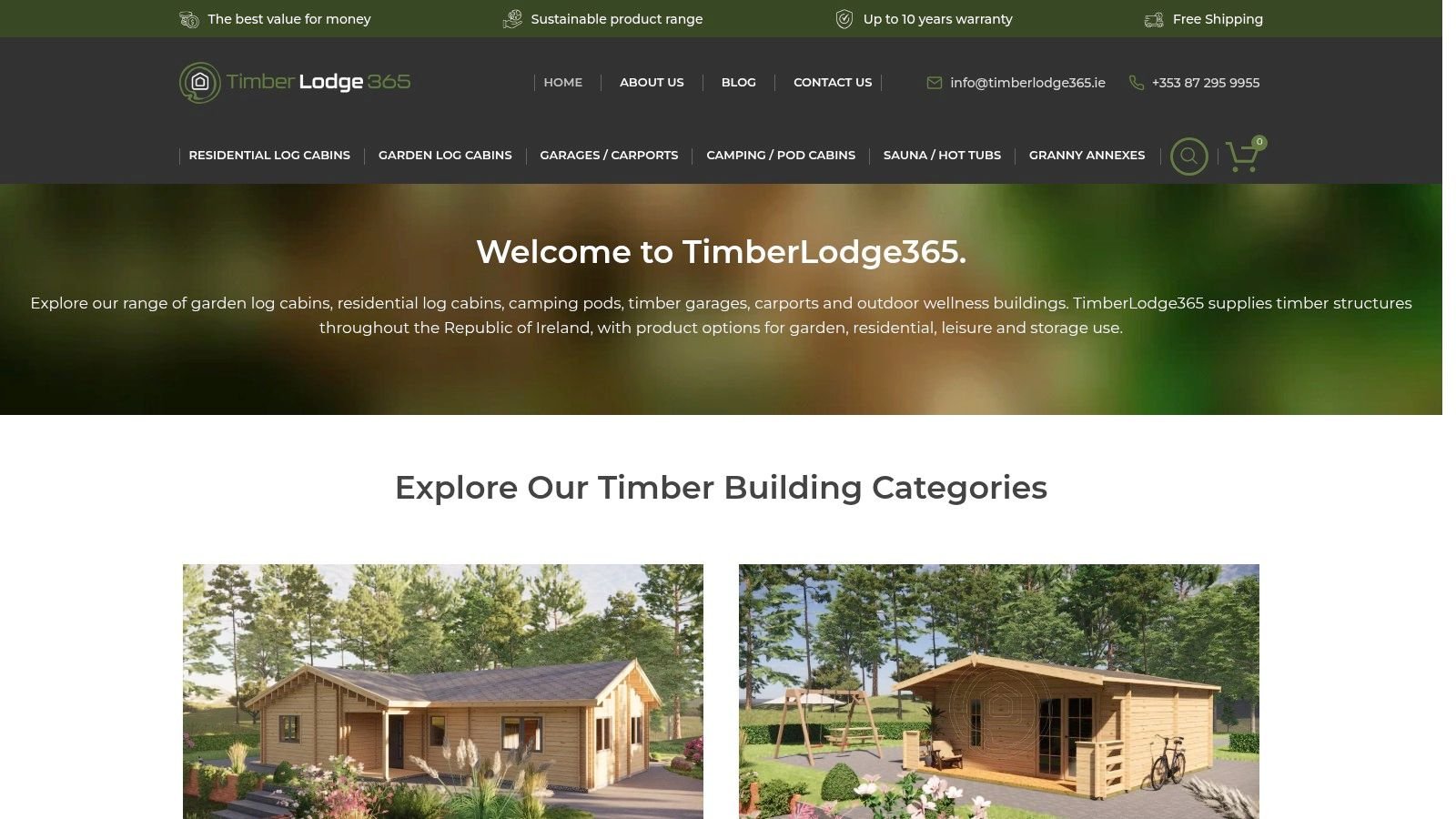
Best fit for a site that needs flexibility
The company's range covers garden log cabins, residential log homes, camping pods, timber garages, saunas, hot tubs and granny-annex options, so the practical decision is less about finding any cabin and more about choosing the one that matches the site's actual use case. If you're planning a home office or hobby room, a lighter-use model may be enough. If you're thinking ahead to year-round use, the published specs make it easier to compare wall build-up, glazing and insulation variants before you buy.
Practical rule: in Ireland, compare the cabin to the garden envelope, not just the brochure photo. A model that looks ideal can still fail the siting or access test if the base, roof height or delivery route doesn't work.
Where it stands out, and where it doesn't
The strongest documented strengths are slow-grown Scandinavian timber, free delivery across the Republic of Ireland subject to suitable access, optional professional assembly, and a 10-year structural warranty on premium buildings subject to the published maintenance terms. That combination is attractive if you want one supplier to cover specification, delivery and installation planning. The buying process also includes a 20–30% deposit with the balance due on the agreed schedule, which can help keep the order process straightforward.
The limitation is equally clear. You still need a flat, solid base sized to the model, and year-round suitability depends on the model and insulation you choose. For a homeowner working within Irish planning rules, that means TimberLodge365 is best treated as a spec-led shortlist tool, not a shortcut around site preparation or permission checks.
What to do with it
Use TimberLodge365 if you want to narrow the field before you even ask for a quote. Compare the published footprint against your clear space, confirm access for delivery, and then verify whether the model is meant for light-use garden space or something more substantial. If you want a deeper product-by-product view, the log cabin range is the most useful starting point for back-garden planning.
2. Loghouse
Loghouse makes sense for buyers who want an Irish supplier with a long paper trail. Its published brochures and installation documentation are useful because they turn the cabin decision into a scope decision, not a guessing game. That's especially relevant in a back garden, where the question isn't only “Will it fit?”, but “What exactly is included if it does?”
Strong when the garden needs a straightforward install path
The supplier's value is in its combination of a broad model range and nationwide delivered-and-assembled installation teams. That matters if the garden has tight access or you'd rather not coordinate a separate installer. A back-garden buyer can use that setup to compare traditional and contemporary cabins, then work backwards from the delivery and assembly requirements instead of hoping the site will cooperate later.
The brochures are also helpful because they show model sizes, extras and delivered prices. That gives the reader a clearer sense of which cabin is just a shell and which one is closer to a complete job. In planning terms, that distinction matters more than many shoppers expect, because an apparently cheaper unit can become less attractive once you account for the missing pieces.
The trade-off to watch
The downside is less about the product and more about the buying process. PDF pricing can date quickly, so the brochure is a planning tool, not a final quote. The site can also be awkward to research at times because of bot protection, which means you may need to check current availability and inclusions directly rather than assuming an old document still reflects the live offer.
A cabin quote is only useful if it names what is and isn't included. Base, assembly, roofing and any upgrade package should all be explicit before you compare it with another supplier.
Best use case
Loghouse suits a homeowner who wants a documented, assembly-led route for a conventional back-garden building. It's a practical option if you prefer an Ireland-based supplier with a visibly established install base and you want to compare several footprints before deciding whether the cabin should be an office, guest space or general garden room. For readers who want to understand why a cabin can be a better property choice than it first appears, the investment guide on log cabins is a useful companion read.
3. Beaver Log Cabins
Beaver Log Cabins is the strongest fit for shoppers who want choice and visibility. Its catalogue is broad, the pricing is easy to see on many models, and the company's Ireland show sites make it easier to judge whether a cabin's proportions work in real life, not just on a screen. For a back garden, that matters because scale is visual as much as it is numerical.
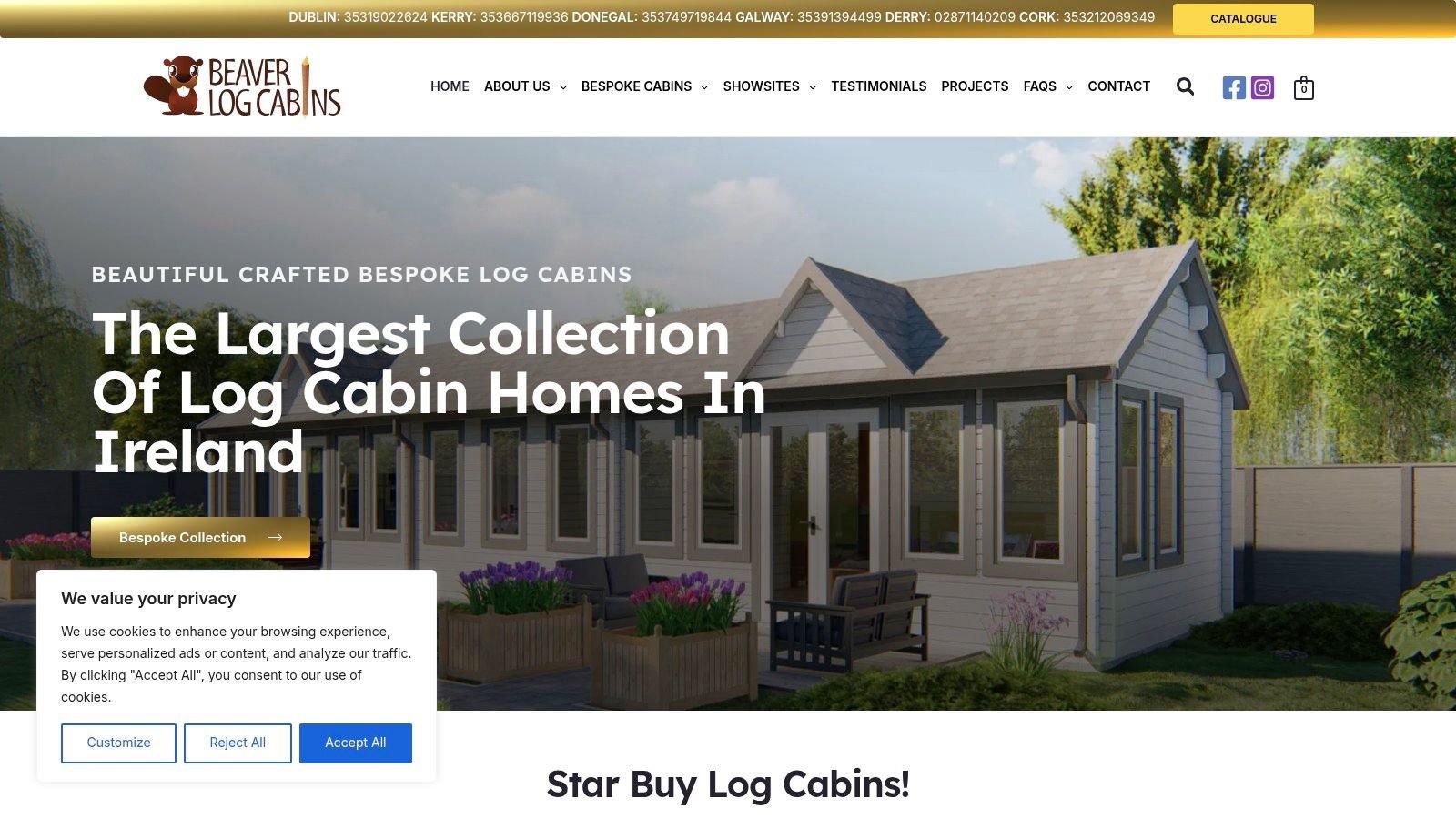
Why it suits footprint comparison
The practical advantage here is model comparison. With multiple show sites in Dublin, Donegal, Kerry and Galway, buyers can inspect several styles before settling on one footprint. That reduces the risk of overbuilding the garden, especially when you're deciding between a compact office cabin and something that starts to feel like a permanent room in the wrong place.
The catalogue also makes it easier to compare similar sizes side by side, which is helpful when you're trying to preserve outdoor space. The more published the dimensions, the easier it is to see whether the cabin will still leave room for a path, storage and a workable planting area.
What to confirm before ordering
Beaver Log Cabins is useful, but some products are clearly kit-priced, so you'll want to confirm what the number includes. That means checking the base, assembly, roofing and any optional extras before you compare it with a fully supplied quote from another seller. For ROI buyers, the fact that the company is registered in Northern Ireland means you should also check VAT, delivery and after-sales terms carefully before you finalise anything.
Best use case
Choose Beaver Log Cabins if you want a large visual shortlist and you care about seeing more than one cabin family before you commit. That works best in gardens where the main challenge is fit and finish rather than a bespoke residential specification. It's also a good match for buyers who like comparing stock and sale pricing, provided they keep the comparison honest and include all the hidden job costs. The product range at TimberLodge365 is a useful benchmark if you want a second set of published dimensions before you decide.
4. Timber Living
Timber Living is built for buyers who want to sit in front of the build, not just scroll through it. The showrooms in Tullow, Cork and Roscommon make it easier to inspect finishes and construction details, which is valuable if you're trying to decide how a cabin will sit beside an existing house or whether it reads like a room or an outbuilding.
Better for a hands-on buying process
A showroom-led supplier is useful when the garden decision depends on feel as much as size. Some homeowners know they want a back-garden office, but they're unsure how much glazing, cladding or roof profile they can live with every day. Seeing those details in person is more helpful than trying to infer them from a sales page.
The company also publishes construction specs, planning guidance and a staged payment plan, which helps buyers map the project sequence. That is particularly useful if you're trying to coordinate the cabin with other works around the house, such as landscaping or a patio build.
What to keep an eye on
The main limitation is that some pricing on site is indicative, so you still need to confirm the exact inclusions for your chosen footprint. Lead times can also shift with seasonal demand, which means a good-looking cabin on a webpage isn't the same as a cabin that can be delivered when your site is ready.
Practical rule: if your access route is narrow or the garden is already landscaped, showroom inspection should happen before you book installation. A cabin that seems compact in a brochure can feel very different when you're standing beside it.
Best use case
Timber Living suits a homeowner who wants a more guided purchase, especially where the cabin's exterior finish and build quality need to be judged in person. It is a strong option for people who care about the sequence, because the company's messaging makes the project feel like a build with steps, not just a box with a price. For back-garden planning, that is often the difference between a tidy installation and a rushed one.
5. Timber Kit Buildings
Timber Kit Buildings is the value-led option for buyers who are willing to take more of the project management on themselves. Its catalogue of Tuindeco cabins, multiple wall thickness choices and 7 to 14 working day delivery on in-stock lines make it especially relevant when speed and budget sit ahead of full turnkey convenience.
Best for compact back gardens and practical budgets
The key benefit is choice at the smaller end of the market. If the garden can only spare a modest footprint, the range of small-to-mid sizes makes it easier to preserve the lawn, a path or space for storage. The clear list pricing also helps when you're comparing a cabin against other ways of adding room without overcommitting the site.
Because the company focuses on supply rather than a full build package, it can suit a DIY or assisted-build approach. That's useful for homeowners who already have a local groundwork contact or are comfortable organising the base separately. In a log cabin back garden project, that division of labour can be efficient if the access is straightforward and you want to control costs.
What needs checking
The trade-off is scope. Assembly may be optional or extra, so you need to confirm whether the quoted price is for the kit only or for a more complete install. You may also need to source the groundwork locally, which means the apparent bargain can shrink once the base and fitting are added.
The log cabins range is a helpful comparison point if you want to see how a fully documented cabin offer looks against a kit-led model. A buyer who is new to garden buildings often underestimates how much the base and fitting matter.
Best use case
Use Timber Kit Buildings if your garden is small, your budget is disciplined and you're happy to manage more of the delivery chain yourself. It is well suited to a buyer who wants a simple footprint, clear pricing and enough flexibility to make the project work without paying for features they don't need. The hard part is being honest about the true installed cost before you order.
6. Eco Home Log Cabins
Eco Home Log Cabins is aimed at buyers who care about insulation decisions earlier in the process. That makes it especially relevant for Irish back gardens, where a cabin that looks fine in summer may not feel comfortable enough once you start using it more regularly. The supplier's range includes 28, 45, 70 mm and glulam 88/130 mm Scandinavian spruce, which gives you a clearer spectrum of construction choices than many buyers see at first glance.
Best when year-round use matters
This supplier is useful if the cabin is likely to become a working room, a hobby space or a longer-stay structure where comfort matters. The emphasis on insulation and upgrade bundles is a practical cue that the building isn't being treated as a casual summer shell. That aligns with Irish guidance that separates lighter garden structures from more demanding habitable use.
The range also includes both flat-pack DIY and fully built or turnkey deliveries, so you can choose the level of installation support that matches your site and your own tolerance for project work. For a back garden, that flexibility is useful because access and disruption often dictate the delivery route as much as the budget does.
What to verify carefully
The marketing needs a sceptical eye. Any claim about being “warmer” than another building should be benchmarked against the written performance data rather than accepted as a universal truth. You should also confirm what is standard and what is extra, especially for roofing, insulation and electrics, because those are the items that usually decide whether a cabin feels usable through the colder months.
Best use case
Eco Home Log Cabins suits buyers who are thinking beyond a basic shed-like room and want the building envelope to do more work. If the intended use is regular, and especially if the room may need to feel comfortable for longer periods, this type of supplier deserves a closer look. The right question is not “Is it a cabin?”, but “How much of the comfort specification is already built in?”
7. Summerhouse24 Ireland
Summerhouse24 Ireland, under Hansa Garden Ireland Ltd, is the factory-direct choice for buyers who want a clear route from warehouse to garden. It's a useful option if you value in-stock availability, crane-delivery logistics and assembly teams, because those services can simplify a project where access and installation are the biggest risks.
Best when logistics are the real constraint
A back garden can fail a cabin project long before planning does because the route in is awkward. A supplier that already thinks about crane delivery and base options is valuable when the cabin needs to arrive efficiently and be placed with less drama. That makes Summerhouse24 appealing for compact urban gardens as well as properties where access is possible, but not generous.
The product mix also tends to be kit-led, with many models using 44 to 70 plus mm wall options and double glazing on many units. That gives the buyer a clearer sense of how the cabin might perform once assembled, especially if they're weighing it against a very light garden room. Factory-direct pricing can be competitive, but only if you compare like with like.
What to confirm before you buy
The main caution is the same one that applies to many kit-led offers. You need to confirm whether professional assembly and insulation packages are included or extra. For Irish buyers, you should also think about planning if the cabin is moving toward overnight or guest use, because a structure intended for sleep is not the same thing as a simple outbuilding.
A cabin can look affordable until assembly, base and finish are added. The only number that matters is the one that reflects the delivered, installed, usable structure.
Best use case
Summerhouse24 suits the buyer who wants a direct supply path, a defined logistics story and a cabin that can be slotted into a site without too much back-and-forth. If the back garden has enough access for the chosen delivery method, it can be a practical way to secure a well-defined kit at a competitive entry point. Just don't treat factory-direct as the same thing as fully finished.
Log Cabin Back Garden, 7-Brand Comparison
| Supplier | Implementation complexity 🔄 | Resource & delivery ⚡ | Expected outcomes 📊⭐ | Ideal use cases 💡 | Key advantages ⭐ |
|---|---|---|---|---|---|
| TimberLodge365 | Moderate, bespoke options and optional pro assembly 🔄 | Free ROI delivery; customer must provide flat, solid base; flexible deposit schedule ⚡ | Durable, high‑quality builds; year‑round use possible with insulation; premium 10‑yr structural warranty 📊⭐ | Homeowners, glamping operators, granny annexes, tradespeople needing tailored builds 💡 | Slow‑grown Scandinavian timber, transparent specs/pricing, nationwide delivery, bespoke design and assembly options ⭐ |
| Loghouse | Low–Moderate, standard models with in‑country install teams 🔄 | Nationwide delivered‑and‑assembled service; printed brochures for budgeting; verify current quotes ⚡ | Reliable, predictable installations backed by large Irish install base 📊⭐ | Buyers wanting an established Irish supplier with full installation service 💡 | Long history in Ireland, large install base, clear brochures for budgeting ⭐ |
| Beaver Log Cabins | Low–Moderate, many in‑stock models; verify kit vs fully built 🔄 | Multiple show sites, visible online prices and frequent promotions; confirm ROI VAT/delivery terms ⚡ | Quick procurement when in stock; easy model comparison across footprints 📊⭐ | Buyers seeking many in‑stock options and promotional deals 💡 | Large digital catalogue, in‑stock models, frequent "Star Buy" offers ⭐ |
| Timber Living | Low, turnkey manufacturer/installer with showrooms 🔄 | Showrooms (Tullow, Cork, Roscommon); staged payments; Irish‑spec construction; lead times vary ⚡ | Turnkey outcomes with ability to inspect finishes; homeowner‑friendly planning guidance 📊⭐ | Buyers wanting a turnkey service and to view finishes in person 💡 | In‑person viewing, transparent build sequence and staging, long Irish experience ⭐ |
| Timber Kit Buildings (Tuindeco distributor) | Low, kit/DIY focused; optional assembly available 🔄 | 7–14 working day delivery on stocked lines; clear list prices; groundwork usually sourced locally ⚡ | Cost‑effective, straightforward DIY/assisted builds; good value for common footprints 📊⭐ | Price‑sensitive self‑builders or assisted‑build buyers 💡 | Wide footprint choice, rapid delivery on stock, clear pricing ⭐ |
| Eco Home Log Cabins | Low–Moderate, flexible from flat‑pack DIY to turnkey 🔄 | Next‑day on selected stock; frequent offers and upgrade bundles; verify inclusions (roofing, electrics) ⚡ | Enhanced insulation options aimed at Irish climate; suitable for year‑round use when upgraded 📊⭐ | Buyers prioritising insulation and thermal performance for year‑round use 💡 | Emphasis on insulation/window upgrade bundles and stocked items for fast delivery ⭐ |
| Summerhouse24 Ireland (Hansa) | Low–Moderate, factory kits with assembly teams available 🔄 | Factory‑direct pricing with Ireland warehouse, crane delivery logistics and free‑delivery flags; confirm extras ⚡ | Competitive factory pricing and fast access to popular SKUs; kit‑led outcomes unless assembly chosen 📊⭐ | Buyers seeking factory pricing with local logistics and optional assembly 💡 | Factory‑direct cost advantages, Irish warehouse/crane delivery, assembly teams available ⭐ |
Turn Inspiration Into a Site Plan
The right cabin is the one that survives the move from inspiration to measurements. Start with the footprint and the delivery route, because a model can look perfect online and still fail in the garden if access is tight or the base area is too small. Then decide what the building is for, work, storage, leisure, or something closer to residential use, because Irish rules treat non-habitable and habitable structures very differently (Irish guidance on garden rooms and log cabins, Irish cabin rules overview).
Compare wall construction and insulation before you compare headline price. A lighter shell may suit a summer office, while a more substantial build is better if you need year-round comfort and less compromise on glazing and moisture control. Then confirm what the quote includes, because base preparation, assembly, roofing, insulation and electrics can shift the final cost and the final usability.
Use this quick checklist before you order. Planning considerations, siting, roof height and remaining garden space. Access and drainage, can the cabin reach the site, and will the base stay dry and level. Glazing and layout, does the internal arrangement suit work, sleep or storage. Delivery logistics, who brings it, who places it and what access they need. Installation responsibility, kit only, assisted build or full assembly. Warranty terms and maintenance, especially timber treatment and any conditions attached to structural cover.
Shortlist the models whose published dimensions and specifications fit the garden, then request a current quote and confirm every inclusion before you pay a deposit. That one step saves more mistakes than any glossy cabin photo ever will. If you want a starting point with clear dimensions, Irish delivery and optional assembly, begin with TimberLodge365 and compare the published specs against your site before you order.