





In Ireland, a small garden log cabin or garden room typically costs about €4,000 to €15,000 up to 15m², then rises to roughly €15,000 to €20,000 for 15 to 25m². If you want a fully finished residential cabin, budget about €650 to €1,200 per square metre.
A lot of buyers still start with the wrong question. They ask for the cheapest cabin price, then discover the full bill only after the base, insulation, delivery, wiring and planning work are added. That's where log cabin cost turns from a neat brochure number into a proper project budget.
Table of Contents
- What a Log Cabin Price Covers
- The Structural Package and What Drives Its Price
- Cabin Formats and Their Price Bands
- Delivery, Assembly and Site Extras That Move the Total
- Planning Fees, Site Costs and the 2026 Exemption Sweet Spot
- Payment Stages and Practical Budgeting Tips
- Why the Cheapest Cabin Is Rarely the Best Value
What a Log Cabin Price Covers
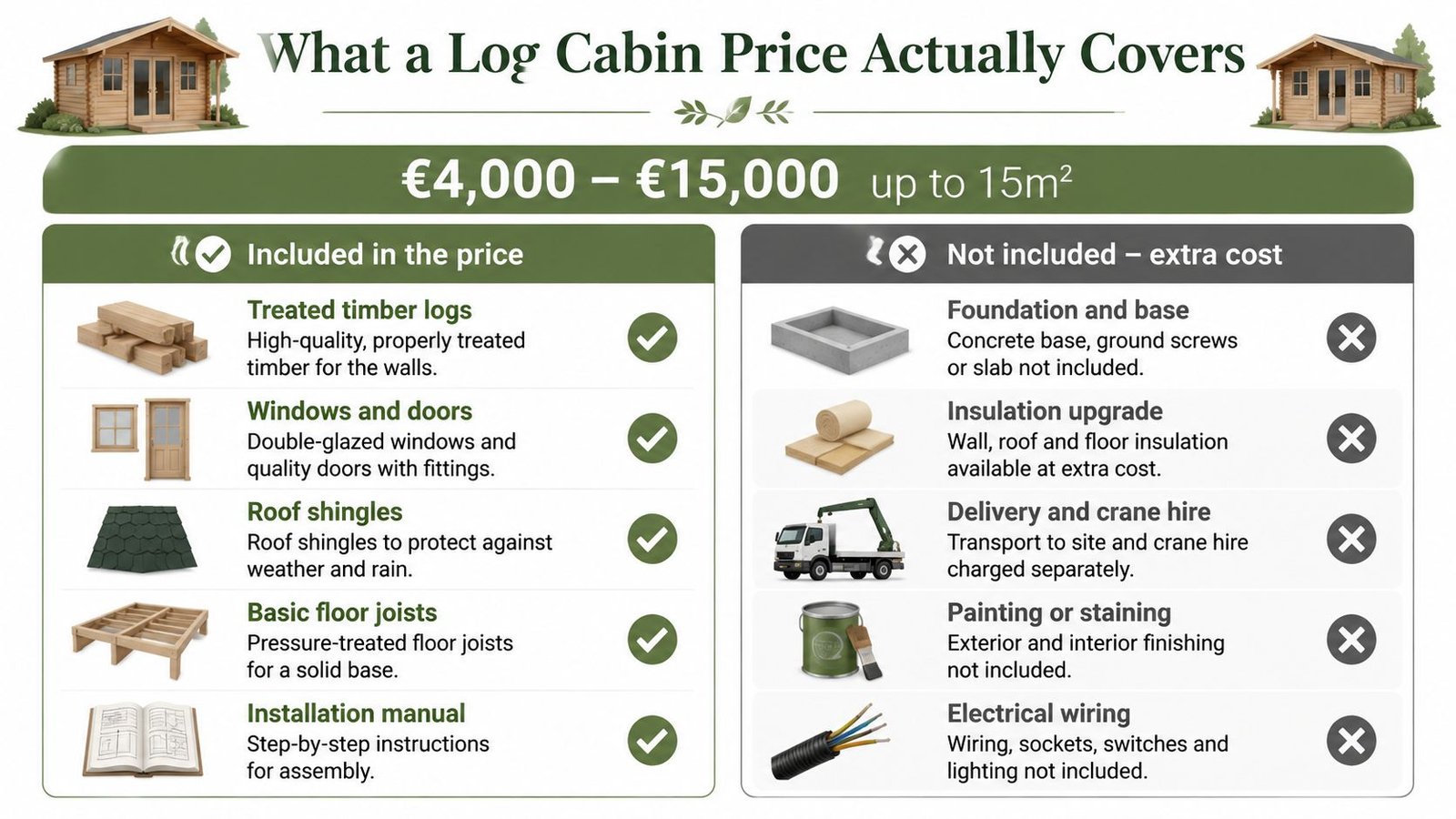
An advertised log cabin cost usually covers the structural package, not the full installed build. That gap matters. Two cabins can carry the same headline price and still land at very different totals once you add the base, insulation, delivery, wiring and finishings. Irish market guides put small garden rooms and cabins at about €4,000 to €15,000 up to 15m², which is a fair starting point, not the end figure for a room you want to use properly all year.
The planning angle matters too. For many Irish buyers, the cleanest route is the size and spec that stays closest to the 2026 exemption sweet spot, because that reduces friction before a shovel even hits the ground. A smaller, simpler cabin often costs less in both the quote and the paperwork. Push size, height or residential spec too far, and the bill rises fast on both sides.
What the headline price usually includes
At minimum, a quote should say whether you are buying timber walls, windows and doors, roof boards, floor elements and a fitting guide. It should also state whether the timber is treated, whether the roof covering is included, and whether the cabin is sold as a shell or as a finished room. A neat-looking price can still leave out the parts that make the building usable.
Wall thickness and glazing are the first things to check. A cabin built with 28mm logs is a lighter garden structure, while 44mm or 70mm logs is a different product altogether. Single glazing is not double glazing, and if one supplier includes floor and roof insulation while another does not, the cheaper quote is usually the dearer route in the end.
Practical rule: compare the quote line by line, not by square metre alone. The shell is only one part of the total spend.
The seven items to price separately
Before you compare suppliers, split the budget into these parts:
- Shell package, the timber structure and main joinery.
- Foundation or base, because a cabin is only as good as what it sits on.
- Insulation, especially if you want year-round use.
- Delivery, which can vary with access and distance.
- Assembly, if you are not self-building.
- Electrical fit-out, including wiring and connection work.
- Finishings, such as painting, staining, gutters and trim.
That checklist makes quote reading much easier. It also shows where a cheap-looking offer is light on essentials, which is how buyers get caught out.
The Structural Package and What Drives Its Price
The structural package is where price differences sit. A buyer can compare two cabins that look similar on paper and still end up with very different totals once the timber spec, roof build, insulation and joinery are spelled out. Irish buyers should read those lines with 2026 planning exemptions in mind, because the cheapest shell is often the one that creates the most friction later. A smaller, simpler cabin is easier to keep inside the exempt route, and that usually keeps total spend under control too.
Wall thickness changes the price fast
Wall log thickness is one of the clearest cost drivers. 28mm logs suit a lighter garden structure. 44mm is a more substantial shell, and 70mm or 90mm+ moves the cabin closer to residential-grade construction. More timber, heavier handling and better joinery all push the price up in steps.
A practical example is a 4m x 3m, 12m² garden room. In 44mm logs, a shell-only figure of roughly €5,500 to €7,500 is a fair Irish benchmark. Move that same format to 70mm with insulated floor and roof, and the price can rise to about €9,000 to €12,000 before delivery. That gap comes from specification, not sales talk.
Keep the planning angle in view. A modest footprint and a restrained spec usually make life easier under the 2026 exemptions, while a heavier build can push buyers toward more planning friction and a dearer all-in result.
Roofing, glazing and treatment are not cosmetic extras
Roofing changes the bill more than many buyers expect. A basic roof board package is cheaper than a tongue-and-groove system, and shingles usually sit below more durable metal roof options in price. Joinery works the same way. Double-glazed windows and doors cost more than basic units, but they are the difference between a summer shed and a room worth using year-round.
Factory treatment and proper gutters are worth paying for too. They raise the upfront spend, but they reduce early maintenance and help the cabin stand up to Irish weather. If a supplier is vague on those items, assume they are not included.
| Structural Package Line Items and Typical Irish Price Contributions | Typical Specification | % of Shell Price |
|---|---|---|
| Wall logs | 28mm to 44mm for lighter cabins | 25% to 35% |
| Wall logs | 70mm and above for heavier builds | 35% to 50% |
| Roof system | Basic roof boards or tongue-and-groove boarding | 10% to 18% |
| Roofing finish | Shingles or upgraded roof covering | 8% to 15% |
| Glazing and doors | Standard joinery or double-glazed units | 15% to 25% |
| Floor package | Basic floor joists or insulated floor build-up | 10% to 20% |
| Treatment and gutters | Factory treatment and proper guttering | 5% to 10% |
The lesson is simple. The shell price tells you what the timber pack costs. It does not tell you what the cabin will cost to use properly, or how cleanly it fits the 2026 exemption route.
Cabin Formats and Their Price Bands
Buyers waste money fastest when they shop for the wrong cabin format. A garden room, a leisure cabin and a residential cabin sit in different price bands for a reason, and those bands only make sense when matched to the intended use. Irish pricing guides show the spread clearly, especially if you read them beside the planning rules rather than as a standalone brochure figure (summerhouse24.ie).
Match the format to the use case
A garden room up to 15m² usually sits in the €4,000 to €15,000 range. That suits an office, hobby room or simple garden use. A mid-range leisure cabin of 15 to 25m² sits around €15,000 to €25,000, which is where many buyers land for a larger multi-use room. A fully finished residential cabin moves into roughly €1,000 to €1,200 per square metre, while broader residential-standard guidance pushes that to about €1,000 to €1,800 per square metre when the build is fully finished (summerhouse24.ie).
Use drives the spend. If the room is for summer use, paying residential money is poor value. If you want permanent occupancy, cutting the specification to save a few euros up front is the expensive choice.
Planning exposure changes with the format
The planning angle matters more in 2026 than many buyers realise. A cabin that stays within exempt garden-structure limits is easier to budget for and far less awkward to progress than one that falls into a full planning route. Once drawings, compliance checks and extra paperwork are in play, the hidden cost is not just fees, it is delay and redesign risk. Keep the size and use aligned from the outset if you want the least friction (doineedplanning.ie).
| Log Cabin Formats Compared by Size, Use and Irish Price Band | Size Range | Typical Use | 2026 Price Band |
|---|---|---|---|
| Garden room | Up to 15m² | Office, studio, hobby room | €4,000 to €15,000 |
| Leisure cabin | 15m² to 25m² | Family room, games room, seasonal retreat | €15,000 to €25,000 |
| Residential shell | Larger custom footprints | Granny annex, year-round shell | €650 to €1,000 per m² |
| Fully finished residential build | Larger custom footprints | Permanent living space | €1,000 to €1,200 per m² |
The cleanest route in 2026 is simple. If the cabin is for day-to-day work or storage, stay in the lighter format and avoid paying for performance you do not need. If it is meant to be lived in properly, buy the residential specification from the start and accept the higher bill.
Delivery, Assembly and Site Extras That Move the Total
A quoted cabin price is usually only the starting point. Delivery, assembly, base work and the small extras behind the scenes are what push the final bill up, and that is where many Irish buyers lose control of the budget. Supplier guidance on log cabins in Ireland shows the same pattern again and again, the shell is the easy number, the installed job is the one.
The extras that usually land on top
Delivery comes first. Free delivery is sometimes included, but only where access is straightforward. Tight sites can force a crane or hiab, and that changes the cost immediately.
Assembly is next. Some suppliers quote a fixed install fee, others price by day or by build complexity. Buyers need the model in writing before they compare quotes, because a cheap shell with open-ended labour is not cheap at all.
Base preparation is the biggest trap. A small cabin still needs a flat, stable base, and once you add levelling, groundworks and concrete or slab preparation, the spend can rise by €800 to €3,000 depending on the site. Electrical connection, painting or staining, anchoring and gutter upgrades sit on top of that. Each one looks minor on paper and becomes expensive once the order is live.
You can see the kind of installed path this creates on the TimberLodge365 back-garden range at https://timberlodge365.ie/log-cabin-back-garden/, where the product price sits beside the delivery and assembly question every Irish buyer has to answer.
A realistic installed-cost example
A €9,500 shell can end up closer to €14,000 once delivery, assembly, base work and electricals are included. That is not an outlier. It is what happens when a bare shell becomes a usable structure. Buyers who budget only for the cabin itself usually meet the rest after the order is already placed.
| Typical Site Extras Added to a Log Cabin Quote in Ireland | Low (€) | High (€) | Notes |
|---|---|---|---|
| Base preparation | 800 | 3,000 | Depends on ground condition and foundation type |
| Delivery | 0 | Variable | Access and distance matter |
| Crane or hiab | Variable | Variable | Often needed on restricted sites |
| Assembly | Variable | Variable | Fixed fee or day-rate model |
| Electrical connection | Variable | Variable | Usually outside headline cabin quote |
| Painting or staining | Variable | Variable | Often left to the buyer |
| Gutter upgrades | Variable | Variable | Worth specifying up front |
If you want a clean comparison, ask for an all-in installed price, not a shell price plus hope. For buyers trying to keep friction low under the 2026 planning rules, the smaller exempt-style garden build is usually easier to budget and easier to finish without surprise add-ons.
Planning Fees, Site Costs and the 2026 Exemption Sweet Spot
Planning can change log cabin cost fast in Ireland. A small exempt build keeps the spend focused on the cabin, while a larger or awkwardly sited structure can pull in drawings, notices and extra professional work. That is the gap buyers miss when they compare headline prices only. The fee on the filing form is rarely the problem.
The sweet spot is size and use, not just price
The best budget position in 2026 is usually the cabin that stays within exempt garden-structure rules and still gives you the space you need. A slightly smaller footprint often beats a bigger one that forces extra paperwork and compliance steps. Buyers who want to keep friction low should start with size and use, then choose the specification that supports that plan.
For a plain explanation of the planning side, see this guide on Irish log cabin permission.
If you fall outside exemption, the extra costs are the ones that bite. Planning-pack fees can run from €500 to €2,000, newspaper notices from €140 to €250, OSi maps from €100 to €150, development contributions around €80 to €130 per square metre, and Irish Water connections can climb to over €6,200 for new connections. Those charges do more damage to the budget than the small filing fee itself.
Site costs still decide the final bill
The site is where many quotes drift. Clearance, access tracks, fencing, service runs, septic work and landscaping sit outside the cabin price, and every one of them adds cost and delay. Buyers often underwrite the building and forget the ground under it. That is where the budget slips.
Keep the build small enough to avoid unnecessary planning friction, then spend the money on the base and specification that improve use.
A clean recommendation is simple. If you are near the exemption line, keep the design straightforward and resist the urge to add size for the sake of it. If the cabin is for a home office or another non-habitable use, check the exemption rules before you stretch the footprint. The planning permission guide for a log cabin in Ireland is the right place to sanity-check the size and use before you commit.
Payment Stages and Practical Budgeting Tips
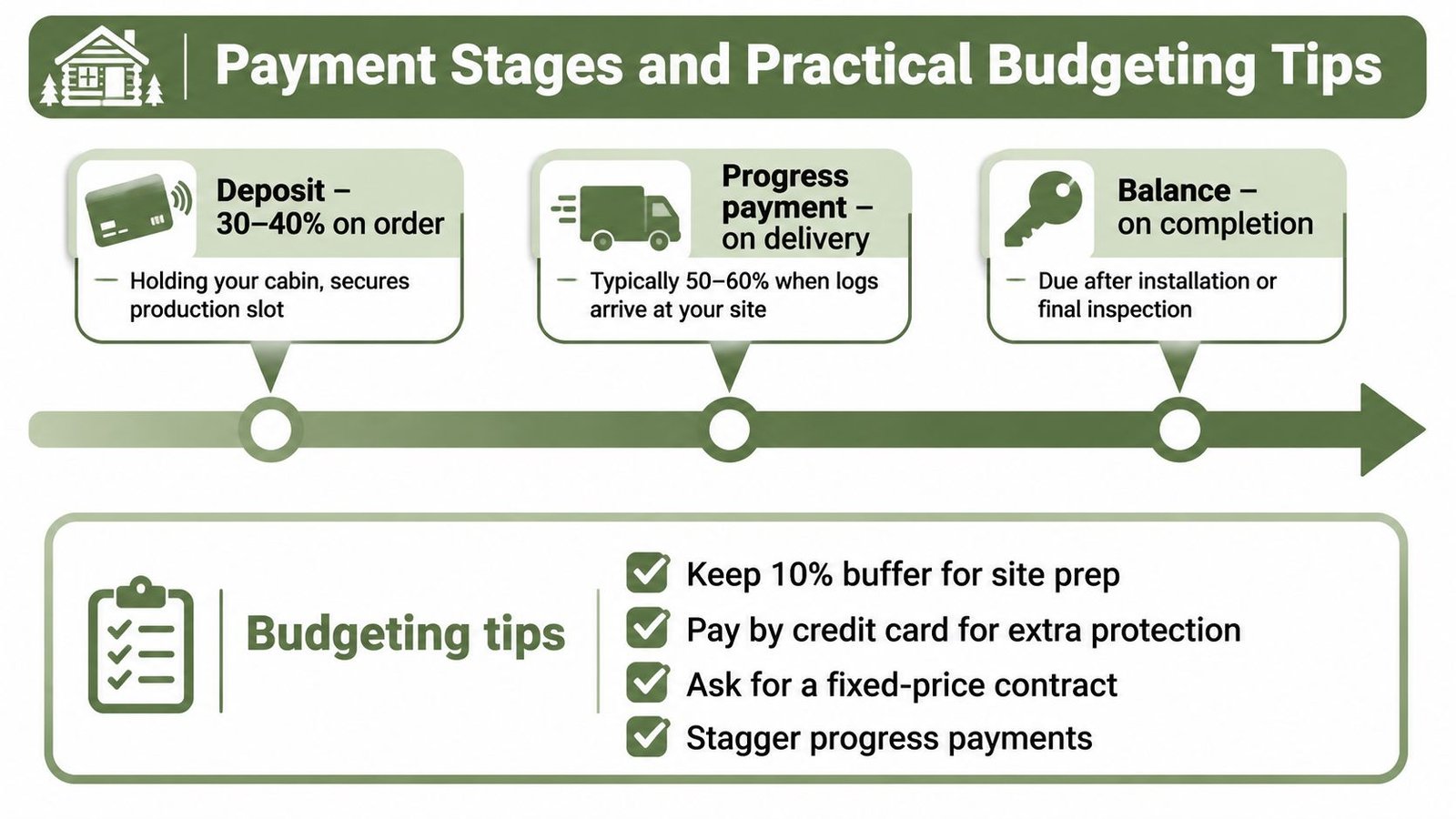
Cash flow matters as much as cabin price. Irish suppliers usually take a deposit when you order, then link the balance to delivery or completion. That protects materials planning and production slots, and it keeps the project moving in the right order. TimberLodge365 says ordering can run on a 20 to 30% deposit with the balance paid to the agreed schedule, which matches the wider market pattern of staged payments rather than one upfront transfer.
Use a staged budget, not a single lump sum
Split the project before you sign anything. Keep a contingency aside, separate the cabin cost from the base and groundworks, and ring-fence assembly and connection money so later invoices do not catch you short. If a supplier wants more than half the total before the cabin is even on site, treat that as a warning sign.
A practical split is straightforward:
- Deposit money, to secure the order and production slot.
- Base and groundworks fund, because the site has to be ready first.
- Assembly and connection fund, which usually lands close to the install window.
- Contingency reserve, because site work nearly always finds one surprise.
Where buyers save money without cutting quality
The easiest savings come from choices that do not weaken the build. Standard sizes cost less than custom footprints. Ordering during quieter periods can soften pricing pressure. Combining electrical work into one visit is cleaner than splitting trades. Self-prepping the base can help on small projects if you know what you are doing.
Five practical savings moves are worth following:
- Choose a standard footprint, because custom dimensions add cost.
- Order when suppliers are less busy, since scheduling pressure affects pricing.
- Bundle electrical work, so you are not paying for repeated call-outs.
- Prepare the base yourself only if you can do it properly, not as a guess.
- Coordinate delivery with a neighbour, if access and timing allow it.
The planning angle matters too. If your cabin sits close to the 2026 exemption sweet spot, keeping the footprint simple reduces friction and avoids paying for size you do not need. Spend the money where it improves the build, not on extra metres that push the project into a harder and dearer path.
Why the Cheapest Cabin Is Rarely the Best Value
The lowest advertised price is usually a trap. It wins the headline by trimming wall thickness, using lighter flooring, dropping proper joinery, or shipping untreated timber that hands the first-year upkeep back to you. That saves money on the quote, not on the project.
A low figure also tells you very little about planning friction. In Ireland, the cabin that sits closest to the 2026 planning exemption sweet spot is usually the smarter buy, because a simple footprint and a realistic spec reduce both site hassle and avoidable spend.
Three price tiers tell the real story
A €3,500 cabin is a budget shell, not a serious year-round building. A €5,500 cabin is usually the middle ground where 44mm construction starts to make sense. A €9,500 cabin buys better timber thickness, more substantial components and a far more realistic path to durable use. Those tiers are not interchangeable, because the materials and the aftercare are different.
| Cabin Price Tiers vs What You Get | Feature | Budget €3,500 | Mid-Range €5,500 | Premium €9,500 |
|---|---|---|---|---|
| Wall thickness | Structural depth | 28mm class | 44mm class | 70mm class |
| Floor build | Basicness | Thinner floorboards | Better standard floor | More substantial floor package |
| Joinery | Windows and doors | Basic or light spec | Better spec | Proper joinery focus |
| Timber treatment | Surface protection | Often untreated | Better treated spec | Factory-treated focus |
| Service life feel | Day-to-day usability | Summer-use only | Sensible mixed use | Stronger year-round potential |
The cheap cabin can cost more over time because the buyer pays for what the supplier left out. Extra painting, quicker weathering, more draughts and earlier wear are common when the spec is shaved to hit a low number.
Warranty and support are part of the price
Written warranty terms, structural certainty and after-sales support belong in the valuation. A 10-year structural warranty on premium buildings, subject to maintenance and terms, is worth factoring in because it changes the risk profile of the purchase. Read the support terms before you read the brochure.
If you want a cabin that holds up, judge the timber grade, wall thickness, glazing, treatment cycle, assembly guarantee and written warranty first. Then check whether the size keeps you in the cleaner planning position rather than forcing you into a larger, messier build. For buyers weighing long-term value, why a log cabin is a strong investment for your property is the right question to ask, not whether the front-page price looks low.
Value rule: if the price is low because the spec is thin, you are buying tomorrow's maintenance today.
The cheapest listing is only a starting filter. Buy the cabin that matches the use, the site and the planning path, not the one that merely looks cheapest on paper.
TimberLodge365 supplies prefabricated timber cabins, garden rooms, residential options and timber garages across Ireland, and it is a sensible place to compare real specifications against your budget. If you are pricing a cabin for a home office, a garden room or a year-round build, visit TimberLodge365 and compare the actual model details before you commit to a quote.