







At least 242 independent outdoor saunas are now active across Ireland, and roughly 90% opened after 2020. That is not a niche hobby, it's a mainstream garden and leisure category, and if you're planning an outdoor sauna Ireland project, you need to treat it like a proper build, not a novelty purchase. The people who get this right start with planning, base prep, electrics, and maintenance, because those are the parts that decide whether the sauna becomes a long-term asset or an expensive headache.

Table of Contents
- Ireland's Growing Outdoor Sauna Culture
- Choosing the Right Outdoor Sauna Type
- Planning Permission and Exempted Development Rules
- Base Preparation, Delivery and Electrical Setup
- Understanding Warranties and Structural Coverage
- Seasonal Maintenance for Ireland's Climate
- Your Action Plan from Order to First Session
Ireland's Growing Outdoor Sauna Culture
Ireland didn't suddenly discover heat and cold therapy in the 2020s. The island has a long sweathouse tradition, with surviving examples still recorded today and historical use stretching from at least the 1600s through the early 1900s. Irish coverage says there are about 300 surviving sweathouses, and BBC reporting notes more than 100 in County Leitrim alone, which tells you how rooted the idea is in the countryside and not just in wellness marketing. The Irish Times overview of sweathouse history makes the point plainly, modern outdoor saunas are being framed as a continuation of an old Irish habit, not a foreign fad.
That history matters because buyers get more confident when the product has cultural legs. Sweathouses were used for ailments such as rheumatism, arthritis, fevers, colds, and respiratory complaints, so the current backyard sauna boom sits inside a familiar Irish logic, heat, rest, cold, repeat. If you're a homeowner looking at a timber sauna, that context should matter more than the social-media gloss.
A market that moved past novelty
The contemporary market has moved fast. Irish coverage says there are at least 242 independent saunas active across the country, with about 90% opening after 2020, and another report said there were already more than 130 outdoor saunas in Ireland earlier in 2025. That kind of jump tells you the category has crossed from curiosity into everyday consumer demand. Spas.ie's sauna boom coverage also shows the spread is national, with Dublin, Cork, Kerry, Donegal, and Wicklow all carrying real operator density.
Practical takeaway: if a product category is spreading across coastal counties and inland towns alike, buyers should judge it like any other garden structure, by siting, durability, and maintenance, not by trendiness.
Pricing also points to repeat use rather than one-off luxury. Irish reporting places a typical session at around €16–€35 for 45–75 minutes, and another report gives a common €15–€30 range. That's not a five-star-only experience, it's a service priced for regular return visits, which is exactly why fixed backyard installations are making sense for homeowners who use saunas often.
Choosing the Right Outdoor Sauna Type
The wrong sauna shape makes a good garden look awkward and can create heating or layout problems you'll regret later. In Irish conditions, the choice usually comes down to barrel sauna, cabin sauna, or a bespoke timber room, and each one solves a different problem. I'd advise homeowners to start with site shape and use pattern, not with the prettiest catalogue photo.
| Feature | Barrel Sauna | Cabin Sauna | Bespoke Timber Room |
|---|---|---|---|
| Footprint | Compact and visually distinctive | More conventional and boxy | Built around available space |
| Heat behaviour | Good circulation through rounded form | Stable, predictable interior volume | Depends on specification |
| Seating layout | Usually tighter and more fixed | Easier to arrange benches and circulation | Most flexible |
| Weather fit | Strong drainage-friendly profile | Strong if roof and cladding are well detailed | Can be tailored to site exposure |
| Garden style | Suits rustic and coastal plots | Blends with sheds and cabins | Best for a coordinated garden scheme |
The rounded barrel shape is popular for a reason. It sheds rain neatly and gives a strong visual identity without looking overbuilt. In a damp coastal setting, that matters. A conventional cabin-style unit is better if you want more usable interior geometry, easier bench placement, and a look that sits comfortably beside a log cabin or garden office.
For buyers with awkward boundaries, a bespoke timber room is the sensible route. It lets you work around access, roof line, and adjacent structures rather than forcing a standard shell into the wrong place. If you're still deciding between sauna and other heat-led options, this sauna comparison helps frame the wider decision around space and usage.
Match the shape to the site
A small urban garden needs restraint. Don't force a large cabin into a narrow plot if the result will choke circulation and make maintenance miserable. A barrel or compact bespoke room often fits better because it keeps the footprint disciplined.
A larger rural site gives you more freedom, but don't waste it. If you use the sauna socially, a cabin with more flexible seating is usually the smarter buy. If it's mainly for solo recovery or couple use, a smaller form will heat more efficiently and cost less to keep tidy.
Rule of thumb: choose the sauna shape that suits the garden first, then the one that suits the photos. That order saves money and avoids regret.
Planning Permission and Exempted Development Rules
The planning test starts with the exemption limits. In the Republic of Ireland, a sauna can usually qualify as exempted development for a garden structure if the combined floor area of all such structures does not exceed 30 m², at least 25 m² of private open space remains to the rear or side of the house, and the build stays within height limits of 4 m for a tiled or slated pitched roof or 3 m for other roofs. Those are the figures that decide whether your project stays simple or becomes a planning job. The The planning guidance summary sets out the practical conditions buyers need to check.
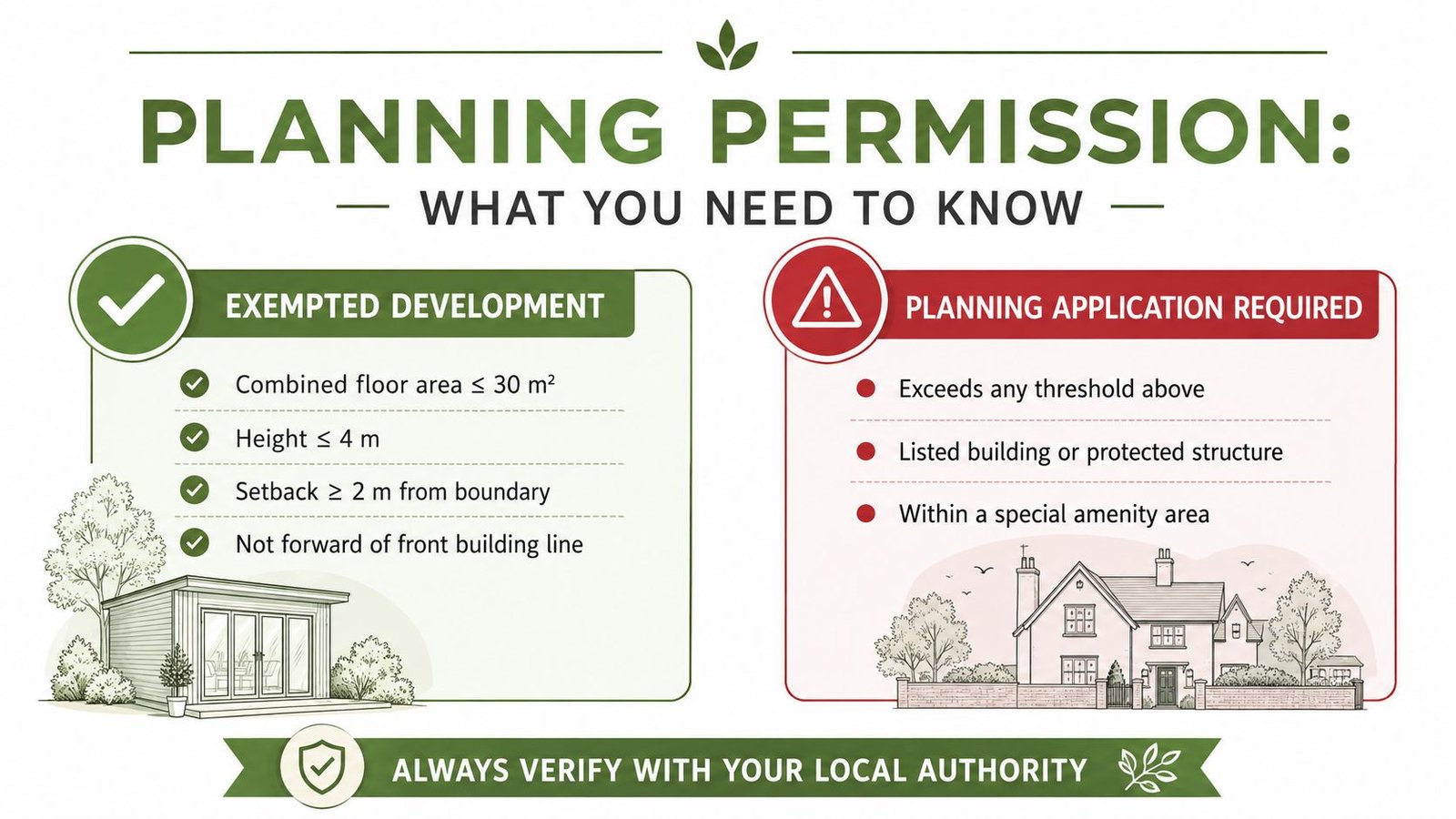
The structure also has to stay incidental to the enjoyment of the house. If it starts to read like separate living accommodation, you are no longer in simple exemption territory. That is why I advise buyers to keep the design honest. Overspecifying the building creates planning risk for no good reason when a smaller, cleaner layout will do the work.
Check the site before you buy
Measure the garden properly. Rough guesses cause trouble, and a sauna that only fits on paper is the wrong purchase. Roof profile matters, boundary position matters, and the total area of garden structures matters.
If the site is near a listed building, protected structure, or special amenity area, verify the position before you order. Those are not places to rely on assumptions. A short call to the local authority can prevent a costly mistake.
Practical rule: if the sauna fits only by bending the site rules, it does not really fit.
Confirm exempt status before you pay a deposit. That keeps the schedule clear and stops a good timber build from turning into an administrative problem.
Base Preparation, Delivery and Electrical Setup
A bad base ruins a good sauna. If the ground is soft, sloped, or uneven, the structure will shift, settle, or twist, and timber will show that movement fast. I want a flat, solid base, usually concrete or paving, set to the product dimensions with drainage planned before the frame arrives. TimberLodge365 supplies outdoor timber buildings across the Republic of Ireland with free delivery nationwide, but delivery does not replace proper access or a sound foundation.
Delivery day should be handled like a site job, not a doorstep drop. Measure the access route, check gates and turns, and clear anything that blocks the vehicle or assembly team from reaching the install point. If you are planning a sauna for a back garden, read the access notes carefully and compare them with a general garden-building setup such as this log cabin back garden guide, because the same access discipline applies.
Get the site ready in this order
- Prepare the base first. The base must be level and able to carry the structure without sagging. Soft lawn, loose gravel, or patchy sleepers are not enough.
- Confirm access before delivery. Check width, turns, overhead obstacles, and any ground that could be damaged by a vehicle or lifting method.
- Plan the electrics before installation day. Do not leave the heater connection as an afterthought.
For electrical work, use IEC 60364-7-703. Irish standards listings reference it for sauna-heater design and set maximum supply voltage of 250 V for single-phase appliances and 480 V for other appliances. The heater, cable sizing, isolation, and protection must be designed as one system. Improvised outdoor wiring is the wrong approach. Bring in a qualified electrician and make sure the heater specification, circuit, and protective devices all match properly.
A proper installation looks plain, and that is the point. The base is level, the vehicle reaches the site, and the electrician signs off the circuit without drama. That is the standard to hold.
Understanding Warranties and Structural Coverage
A warranty sounds simple until you read the conditions. The premium timber sauna warranty framework used by TimberLodge365 includes a 10-year structural warranty, but that doesn't mean every part of the sauna is covered, and it definitely doesn't mean you can ignore maintenance. The warranty page at TimberLodge365 warranty information should be read as part of the buying decision, not after the build is delivered.
What structural coverage usually protects
Structural warranty coverage is about the timber frame, joints, and the building's ability to remain sound when installed and maintained correctly. It is not a blanket promise over every component in the sauna. Wear items such as heater elements, door seals, and interior fittings are normally treated differently from the structural shell itself.
That distinction matters because buyers often assume the warranty is broader than it is. It isn't. If a part wears out through regular use, that's maintenance, not structural failure. The more honest you are with yourself about that now, the better.
Practical advice: keep every maintenance record. If there's ever a warranty query, proof of care is your strongest position.
Conditions that keep the warranty valid
The base has to be right. The timber has to be treated on schedule. Published maintenance guidance has to be followed. Timber structures in this category are usually expected to receive treatment every 2–3 years, depending on exposure and product instructions. Skip that work, and you're weakening the very protection you bought.
Some homeowners cut corners and pay for it later. They assume a garden sauna can be left like a shed. It can't. It's a heated timber building, exposed to weather, steam, condensation, and regular thermal movement.
The clean approach is simple, build it correctly, service it regularly, and keep the paperwork. If you do that, the warranty is there to back a well-maintained structure, not to rescue a neglected one.
Seasonal Maintenance for Ireland's Climate
Ireland's climate is damp enough that timber care can't be occasional. Moisture is the issue, and moisture never really goes away here, it just changes form. Slow-grown Scandinavian timber is a sensible material choice for Irish outdoor buildings because it handles movement and weathering well, but it still needs regular attention if you want the sauna to stay clean, dry, and tight.
Spring and summer care
In spring, inspect the timber for moisture damage, dark staining, and any signs of lifted grain. Reapply a suitable preservative treatment where the manufacturer calls for it, especially on the more exposed faces of the structure. Don't wait until something looks visibly wrong, because by then the surface has already been working against you.
Summer is about airflow. Leave the door open after use when safe to do so, keep vents clear, and clean ventilation grilles. Humid weather and repeated hot sessions create the right conditions for stale smells and surface mould if air can't move properly. I'd also check the interior benches and backrests for residue and wipe them down regularly with a soft cloth.
Autumn and winter discipline
Autumn is your warning period. Check roof seals, door gaskets, and all the joints that keep water out before winter weather arrives. If you have any moving or treated metal fittings, give them attention before cold, wet months make access annoying. If your sauna has any water system, drain and winterise it before temperatures drop.
Winter care is about safety and load. Keep an eye on the heater and the surrounding clearances, and remove any accumulated snow load from the roof if your model and site exposure make that necessary. Also monitor humidity inside the sauna so condensation doesn't linger after use.
Here's the straight answer on timber treatment, use a product suitable for exterior timber, follow the manufacturer's application guidance, and don't assume one coat lasts forever. In Irish conditions, regularity matters more than optimism.
Your Action Plan from Order to First Session
A good outdoor sauna project in Ireland runs on sequence, not luck. Week 1, confirm exempted-development status with your local authority or planner. Week 2 to 3, place the order and lock the delivery window. Week 4, get the base poured or paved and clear the access route. Week 5, bring in the electrician and schedule final sign-off.
That order matters. The sauna should arrive to a ready site, not a site still being argued over, levelled, or wired. If you force the timeline, you pay for it in delays and rework.
Once the build is installed, do a full handover check. Confirm heater operation, door fit, ventilation, and any finish or treatment requirements before the first session. Then keep the maintenance plan realistic, because timber in Irish weather needs regular attention if you want the structure to last.