







You're standing in a cold back garden, looking at the space beside the home office, and trying to decide if a compact cabin sauna is sensible or just another wellness purchase you'll regret by February. That's the infrared sauna Ireland question, not whether infrared sounds modern on a product page. It's whether the cabin fits your garden, your wiring, your tariff, and your actual habits.
| Decision point | Infrared sauna | Traditional sauna |
|---|---|---|
| Heat style | Radiant panels warm your body directly | Hot air and stones heat the room |
| Typical session feel | Lower heat, longer sits | Harder heat, shorter sits |
| Install profile | Easier to retrofit into smaller spaces | Better when you want a dedicated sauna build |
| Running cost | Lower wattage, tariff still matters | Higher energy demand and more heat-up overhead |
| Best fit | Compact home use, lower heat tolerance | Social ritual, hotter sauna experience |

Irish buyers aren't coming at this from zero. Independent reporting in 2025 and 2026 said there are at least 242 independent saunas active across Ireland, with roughly 90% opened since 2020 and more than half launching in 2025 alone, which shows how quickly sauna culture has gone from niche to mainstream in the Republic of Ireland. That matters because infrared cabins are now being sold into a market that already understands sweat bathing, garden wellness, and home leisure spaces, not a market that needs convincing from scratch. Irish sauna market reporting
Table of Contents
- Why Irish Buyers Are Looking at Infrared Saunas
- How Infrared Saunas Work
- Infrared Compared With Traditional Saunas
- What an Infrared Sauna Costs to Run in Ireland
- Planning Permission and Garden Siting Rules
- Buying Versus Membership in Ireland
- Which Sauna Suits Which Irish Buyer
Why Irish Buyers Are Looking at Infrared Saunas
A homeowner in Mayo, Meath, or outside Cork usually does not want an infrared cabin because it looks good in a brochure. They want a heater that fits a garden room, avoids a planning mess, and does not turn into a heavy electricity bill. That is the reason infrared is getting attention in Ireland.
Ireland also has a long sweat-bathing tradition that predates the current infrared wave. Irish sweathouses, small stone sweat-bath structures linked to sauna-like practice, are documented from the 17th century, and about 300 still stand across the island today, even though thousands are believed to have existed in the past. One Irish source says more than one-third of identified sweathouses are in Leitrim, and historical use continued roughly from the early 1600s to the early 1900s for complaints including rheumatism, arthritis, fevers, and respiratory issues. Infrared saunas do not feel foreign here, they sit inside an older Irish wellness story. RTE on Irish sauna traditions
What this guide helps you decide
The useful question is not whether infrared sounds healthy. The useful question is whether it suits your garden, your electricity supply, and your actual usage pattern better than a traditional sauna, a spa membership, or no sauna at all.
Practical rule: if the sauna has to sit beside a home office or cabin you already own, planning and electrical fit matter more than glossy features.
Irish buyers should judge the purchase on practical ground. Check whether the unit fits your layout, whether your wiring can take it, what your tariff does to the hourly running cost, and whether the siting rules create extra work. That is the difference between a cabin that gets used and one that becomes expensive storage.
This guide stays on those points. It gives you the Irish context first, then the heat type, real running cost, planning rules, and the choice between buying and joining a facility.
How Infrared Saunas Work
Infrared saunas do not heat the whole room like a blast furnace. Radiant panels warm your body directly, so the air stays cooler than in a hot-stone cabin while you still work up a strong sweat. Irish buyers should understand that before they compare units on price alone.
The experience feels different too. In a traditional sauna, the cabin air does most of the work, so the whole space feels hot. In an infrared cabin, the heat is concentrated on the body, which many people find easier to sit in for longer. It is controlled radiant warmth, not air roasting.
The heater types you'll see on Irish listing pages
Irish listings usually show quartz heaters and carbon heaters. A recent Ireland-focused market snapshot shows 66% of units used quartz heaters and 34% used carbon heaters. Quartz units are usually sold for stronger output, while carbon panels are marketed for more even heat spread and lower surface temperatures. Irish infrared market snapshot
The operating range matters more than the marketing terms. Irish consumer pages commonly describe infrared cabins as working around 40 to 55°C or up to about 65°C, which is well below the heat people expect from a Finnish-style sauna. That lower range is why infrared often suits someone who wants a gentler session after a run, a walk, or a long day at a desk.
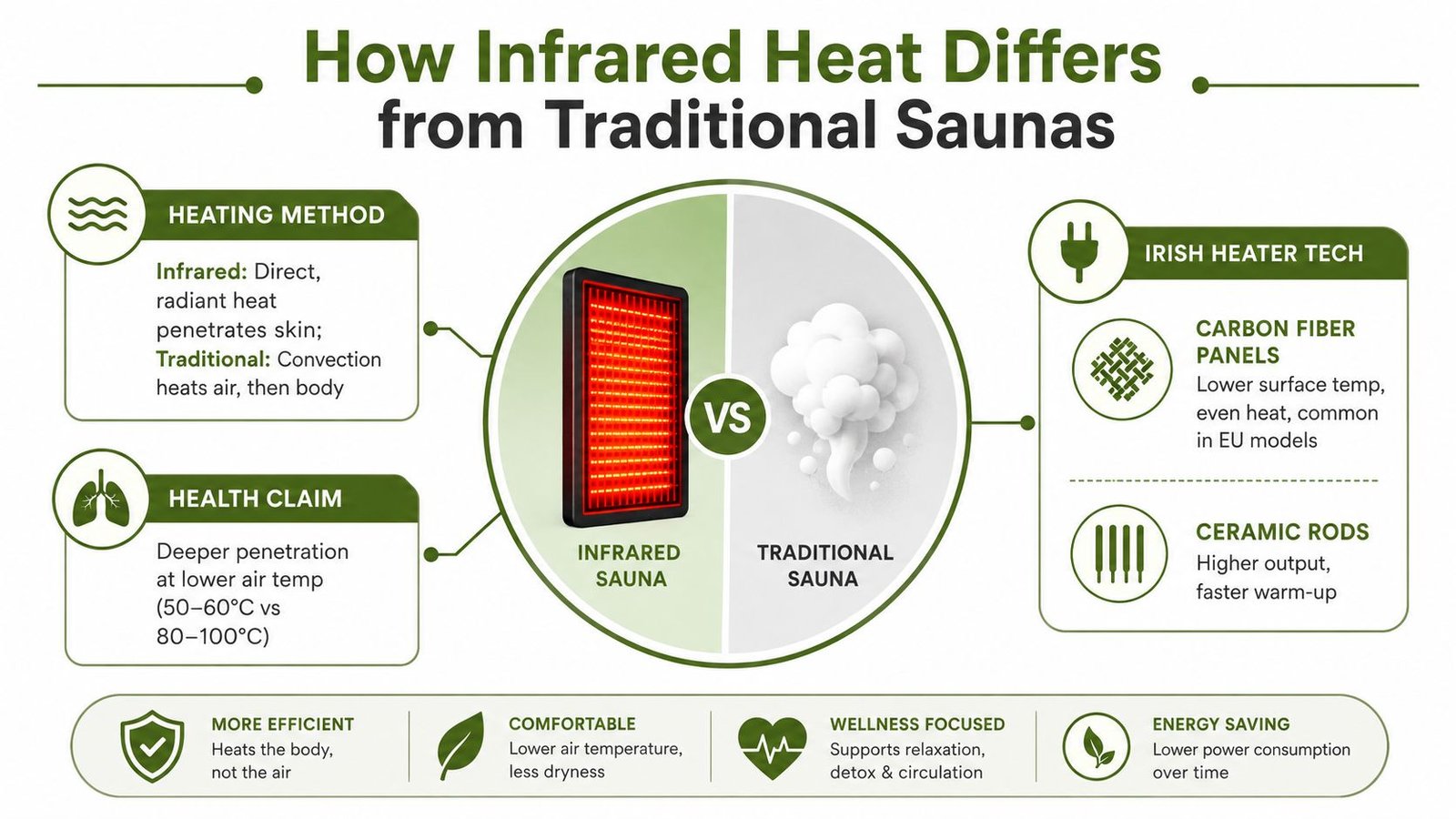
Infrared is a body-warming cabin, not an air-blasting room. That makes it easier to place in a house, garden room, or compact leisure space. It also means you should not buy one if what you really want is the intensity and ritual of a full Finnish sauna.
Infrared Compared With Traditional Saunas
The cleanest comparison starts with what changes the user experience. Infrared cabins are lower-heat, lower-footprint, and easier to retrofit. Traditional saunas are hotter, more ritual-led, and often better when you're building a dedicated wellness structure from scratch.
| Criterion | Infrared Sauna | Traditional Sauna |
|---|---|---|
| Typical heat | Lower operating range, commonly around 40 to 65°C | Hotter room, usually chosen for a more intense sweat |
| Session feel | Longer, more comfortable for many users | Shorter, more intense, more social |
| Warm-up | Usually quicker to reach usable heat | Needs more heat-up time and a stronger initial push |
| Electricity demand | Lower than a full hot-room build, but still needs proper planning | Higher demand, especially if you're heating a larger room |
| Installation footprint | Compact and easier in a garden room or retrofit | Better suited to a purpose-built sauna area |
| Ventilation and humidity | Simpler because the room isn't built around steam or stone heat | More demanding if you want the classic sauna atmosphere |
| Best fit | Homeowners who want convenience and repeat use | Homeowners who want heat intensity and the sauna ritual |
The practical split is simple. If you're trying to tuck a unit into an existing structure, infrared usually wins. If you're designing a standalone wellness building and want the full hot-room experience, traditional still makes more sense.
Practical rule: choose infrared when the room is the constraint, choose traditional when the heat ritual is the point.
For Irish buyers, the other difference is how often the unit gets used. Infrared works well when you want a repeatable, lower-friction routine. Traditional saunas work better when the session itself is the event, not just the recovery tool. That's why the right choice is less about “which is better” and more about whether you're buying a daily habit or a weekend experience.
What an Infrared Sauna Costs to Run in Ireland
The headline running cost on an Irish home infrared sauna is not dramatic, but it isn't trivial either. A 1.5 kW two-seater is estimated to cost about €0.58 per hour at Electric Ireland's lowest rate and about €0.93 per hour at the highest cited rate, with an average of €0.76 per hour. That works out to roughly €17.53 to €28.02 per month for one hour of daily use, with an average monthly figure of about €22.77. Irish infrared running cost estimate
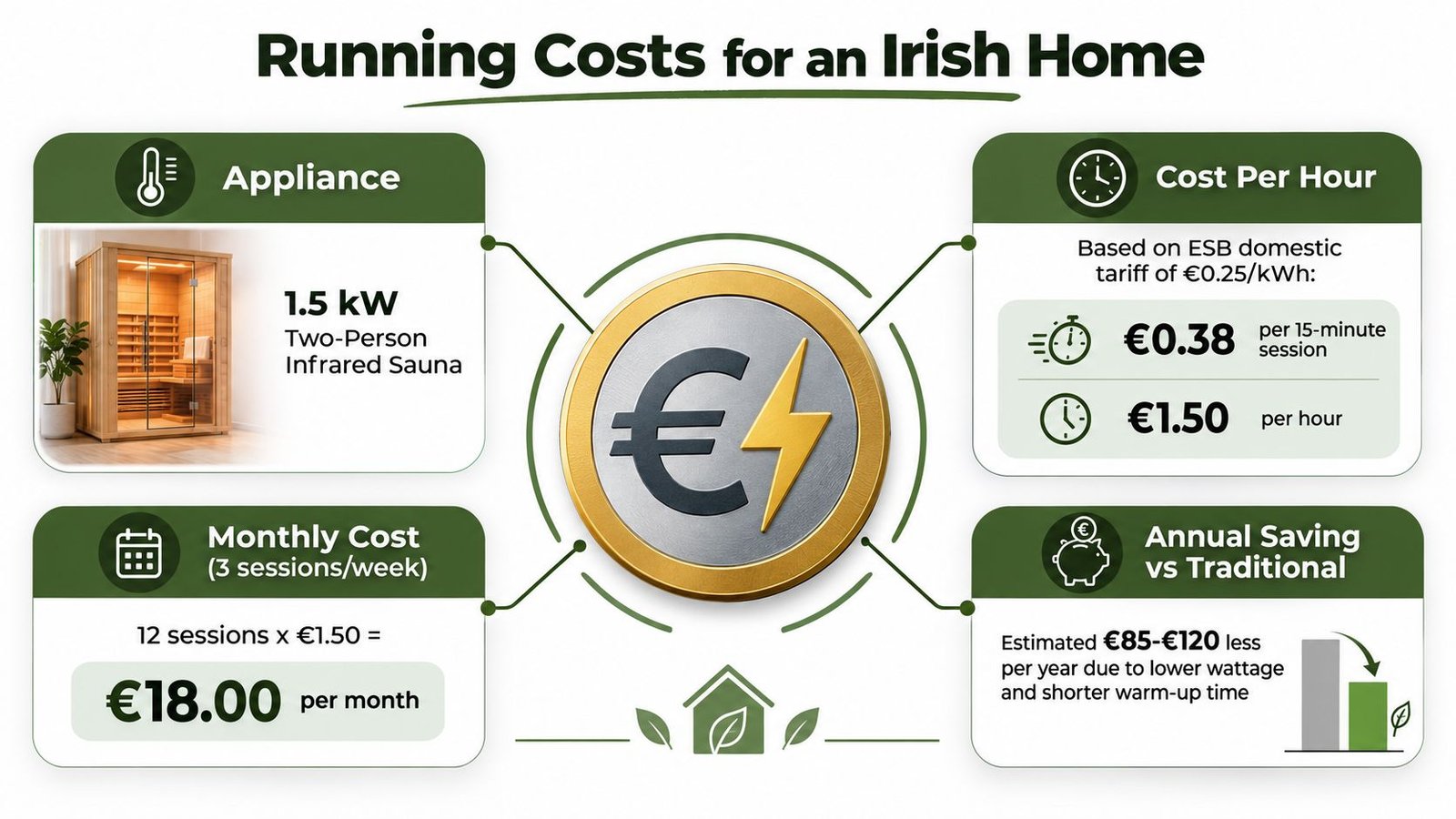
That spread matters. The same sauna can swing by more than 50% in monthly cost depending on the tariff, which means the wrong electricity plan can eat up part of the savings people assume they're getting by choosing infrared. Buyers often compare heater wattage and ignore the tariff they're already on, and that's backwards. The bill is driven by both.
What to check before you buy
- Your domestic tariff: the same cabin costs more to run on a higher-rate plan.
- The heater size: a 1.5 kW two-seater is a useful benchmark, not a guarantee of your final bill.
- Your usage habit: occasional weekend sessions and daily one-hour use are very different cost profiles.
- Installation context: if the sauna sits in a colder outbuilding, your real-world experience may differ from showroom expectations.
Practical rule: don't compare infrared cabins on purchase price alone, compare them on purchase price plus your own unit rate.
If you're looking at a specific TimberLodge365 model, start with the spec sheet, then check your tariff, then ask the electrician what the circuit can safely support. The order matters. A cheap cabin with the wrong supply can become an expensive mistake. TimberLodge365 infrared sauna listing
Planning Permission and Garden Siting Rules
A lot of Irish buyers get caught out, because the sauna itself is only part of the problem. If you're adding an infrared cabin beside a garden office, a shed, or another timber structure, the cumulative footprint on the site is what matters, not just the footprint of the sauna.
Irish guidance says exempted development for domestic garden structures increased from 25 to 30 square metres on 27 July 2026, while still requiring at least 25 square metres of remaining private open space. The same guidance keeps the height limits at 4 metres for tiled or slated pitched roofs and 3 metres for other roofs, and the structure must not sit forward of the house's front wall. Irish planning guidance for garden structures
What that means in real gardens
A lot of people think, “It's only a sauna, so it'll be grand.” That's the wrong way to look at it. If you already have a garden room, a cabin office, or a shed, the new sauna may tip the site over the exempted area limit even if the sauna itself is small.
Use this checklist before you commit:
- Measure the existing structures: include cabins, offices, sheds, and any other exempted buildings.
- Check the remaining open space: you still need the required private open area.
- Confirm roof height and shape: the limit changes depending on roof type.
- Watch the position in the garden: don't place it forward of the front wall of the house.
- Speak to the local council early: don't rely on a sales brochure to tell you the planning story.
The old habit of treating a sauna as a standalone add-on doesn't work well in Ireland anymore. If the site already carries other garden buildings, the project has to be planned as a whole. That's especially true for buyers who want a sauna near a home office or a leisure cabin, because those are exactly the sites where area and setback rules can collide.
If the layout is tight, draw the whole garden to scale before you order anything. Most planning problems start with assumptions, not with the sauna itself.
Buying Versus Membership in Ireland
This is the simplest commercial comparison in the whole decision. Irish market listings show home infrared saunas priced from about €2,299 for a 2-person unit up to €3,250 to €6,950 for different models, while one Irish operator lists sauna access at about €15 per session or €60 for five sessions. Irish infrared sauna pricing and access
The maths is straightforward. If you're using a sauna frequently, home ownership starts to make sense because the cost per session drops once the cabin is installed. If you're using it occasionally, public access is the cleaner choice because you avoid the upfront spend, the electrical work, and the siting hassle.
Where ownership usually wins
A home infrared unit makes the most sense when you already know you'll use it often, especially if you're building a routine around recovery or relaxation. If the sauna is going into a garden room you already own, the added value is convenience, not novelty.
For one Irish buyer, the question isn't “can I afford the cabin”, it's “will I use it enough to justify the cabin plus electricity plus installation”. That's why the internal service side matters too, including assembly support such as TimberLodge365 assembly service, especially if the unit is going into a tight backyard or beside another structure.
If you're still unsure, compare the cost of a year of occasional public sessions against the total first-year ownership cost. In many Irish cases, the right answer is not pure ownership or pure membership, it's whichever option matches how often you'll sit in the sauna.
Which Sauna Suits Which Irish Buyer
If you are fitting a sauna into an existing garden room, want lower running costs, and do not need intense heat, infrared is the better buy. If you are building a dedicated outdoor wellness structure and want the full hot-room ritual, traditional is the stronger choice.
Infrared suits the homeowner who wants a tidy, repeatable routine. It works for people who are happy with lower temperatures, care about electrical efficiency, and do not want to rebuild half the garden to make space. Traditional suits the buyer who wants the room to feel hot, social, and properly sauna-like.
My recommendation by buyer type
- Choose infrared if you already have a garden room, need a compact footprint, or want a lower-heat experience you will use regularly.
- Choose traditional if you are building a purpose-made wellness structure, want humidity and heat intensity, or see the sauna as a social feature rather than a personal routine.
- View the full range at TimberLodge365's sauna and hot tub category before deciding, and walk away from both if the garden is too tight, the circuit cannot support the load, or the site layout creates a planning risk you are not ready to manage.
The electrical side is not optional. Infrared cabins and sauna heating appliances fall under IEC 60335-2-53 as adopted by NSAI, covering infrared cabins up to 20 kW rated power input, with rated voltage limits of 250 V for single-phase units and 480 V for other appliances. That means a small cabin still needs proper electrical checks, not guesswork. NSAI sauna appliance standard
If you are buying for an Irish garden, treat the decision as a fit test, not a lifestyle fantasy. Confirm your tariff, measure the full garden footprint, decide between quartz and carbon heaters, and ask the installer or electrician to confirm compliance and circuit capacity before you pay a deposit.
If the numbers and the site do not line up, do not buy yet.